Artificial intelligence is changing the way finance and accounting teams work today. Routine tasks can now be supported by tools that process information faster, detect patterns and reduce manual work.
For future accountants, this raises a question: where does professional human judgement matter most?
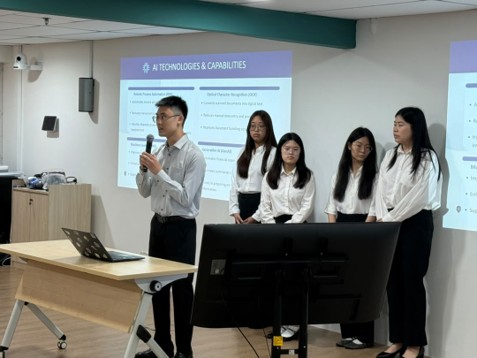
(From left) Poh Hui Jie, Teh Shi Xian, Sarah Goh Jia Wen and Khor Khai Wen, with presenter Ooi Jun Ye delivering the Champion team’s AI project presentation.
Nine accounting and finance students from INTI International College Penang explored this through an Employer Project with Infineon Technologies. Working in two teams, they developed consulting-style proposals recommending how AI could be applied to Finance and Accounting functions within a Global Business Services (GBS) environment, including areas such as invoice processing, cash flow forecasting, fraud detection and compliance monitoring.
The students, from the Bachelor of Arts (Honours) Accounting and Finance 3+0 programme in collaboration with the University of Hertfordshire, UK, had to look beyond classroom theory. Guided by lecturers Henry Ooi and Christine Gan, they studied industry practices, assessed AI applications and developed proposals that considered efficiency, decision-making, governance and implementation risks.
The winning team comprised Khor Khai Wen, Poh Hui Jie, Ooi Jun Ye, Sarah Goh Jia Wen and Teh Shi Xian, while Darius Goh Wey Li, Reign Chong Hui Min, Ch’ng Xin Nee and Choo Li Zi emerged as the first runner-up team.
For the winning team, the project changed how they understood AI.
“Before this project, our biggest misconception was that AI was simply an advanced chatbot that could answer questions or generate text,” said Teh Shi Xian.
“This project changed our perspective, helping us realise that AI is not just a conversational tool but a powerful business solution that enhances operational efficiency, supports better decision-making, and enables accountants to focus on higher-value, strategic responsibilities,” she said.
The first runner-up team began with a different concern. They were unsure whether AI could perform accounting tasks on its own and reduce the need for people.
“We used to think that AI could complete the job independently without intervention, which causes a risk of people losing their jobs,” said Choo Li Zi.
As they examined the use of AI in finance and accounting, their view became more balanced. AI could support repetitive tasks, analyse information and identify trends, but people would still be needed to interpret results, question outputs and make decisions that require context.
That became one of the clearest lessons from the project. AI may change accounting work, but it does not remove the need for accountants. Instead, it changes the value accountants are expected to bring.
The students also learned that recommending AI solutions is not as simple as naming technology. In a business environment, every proposal has to be practical, evidence-based and aligned with organisational needs.
Rather than relying only on textbook theories, they studied company reports and industry practices to evaluate how AI could improve finance and accounting processes.
“We had to support every recommendation with credible evidence and consider both the benefits and potential risks of AI adoption,” said Khor Khai Wen.
This also introduced them to AI governance, including audit trails, transparency, data reliability and regulatory expectations.
“We realised that every proposal had to be backed by reliable data, industry benchmarks, and real company examples before it could be considered credible. Presenting our findings felt less like a university presentation and more like delivering a business proposal to management,” said Khor.
For the first runner-up team, this led to a human-in-the-loop approach, where employees work alongside AI while moving towards higher-value responsibilities.
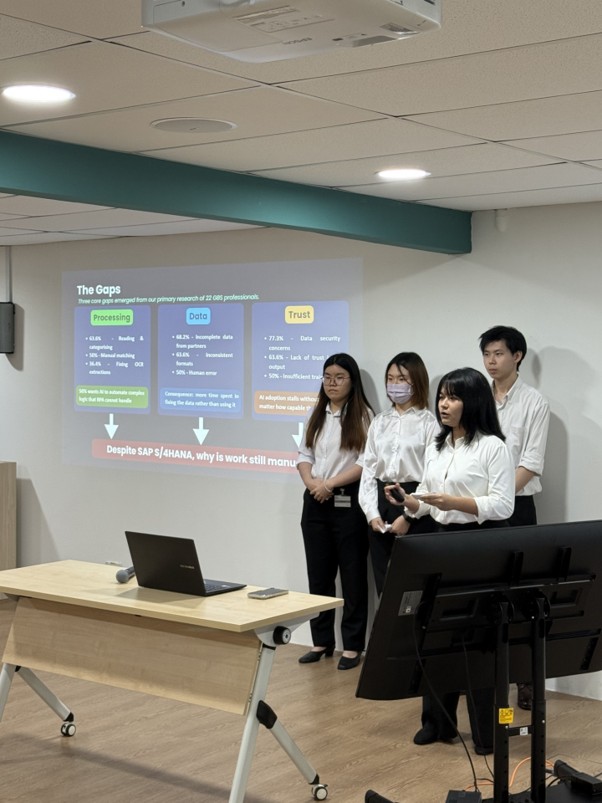
Members of the first runner-up team present their proposed AI solutions to address finance and accounting challenges within a Global Business Services environment.
For Henry Ooi, Lecturer at the School of Business, the project showed how quickly students moved from discussing AI in general terms to thinking about business needs.
“I was impressed by how quickly the students moved beyond simply discussing AI as a technology and instead focused on solving business problems,” he said.
Beyond the project itself, Henry said the experience gave students a clearer view of how the accounting profession is evolving. As AI supports routine processes, accounting graduates will be expected to spend less time on manual tasks and more time on analysis, risk management, business partnering and decision-making.
“Today’s accounting graduates are no longer expected to perform only routine transactional work,” he said. “AI is automating many repetitive accounting tasks, allowing professionals to focus more on analysis, business partnering and strategic decision-making.”
The project made the future of accounting feel less distant. AI was no longer an abstract technology trend or something to fear from a distance. It became a tool the students had to examine carefully, explain clearly and use responsibly.
Even as AI takes on more routine processes, the accountant’s role does not disappear. It shifts towards understanding the numbers, asking better questions and deciding what the information means for the business