Ovarian cancer can be difficult to treat, particularly when it is diagnosed at an advanced stage. Tumours differ from one patient to another, and some cancer cells develop ways to resist chemotherapy. A treatment that shows promise in the laboratory may therefore need years of further work before its benefits for patients are clear.

Prof Goh Khang Wen of INTI International University’s Faculty of Data Science and Information Technology co-authored a review examining liposome-based drug delivery for ovarian cancer.
A review co-authored by Prof Goh Khang Wen of INTI International University’s Faculty of Data Science and Information Technology (FDSIT) examines research from around the world into one way of improving treatment delivery: using tiny carriers called liposomes to transport cancer medicines.
The paper, titled “Liposome-based nanocarriers for Ovarian cancer: Molecular targeting, therapeutic mechanisms, and clinical translation,” was published in Colloids and Surfaces B: Biointerfaces in 2026. It looks at how liposomes are being designed, what researchers have learned so far and what stands in the way of wider clinical use.
Liposomes are microscopic structures made of lipid layers that can hold medicines. One liposomal medicine is already used in ovarian cancer care, while researchers continue to study newer designs that may help deliver treatment more effectively.
Some of these designs add molecules to their surfaces that can attach to specific structures on ovarian cancer cells. The aim is to help those cells take up the medicine while potentially reducing exposure to healthy tissue.
Researchers are also studying liposomes that carry chemotherapy together with other substances intended to counter drug resistance. This matters because some cancer cells can reduce the amount of medicine they retain, allowing them to survive treatment.
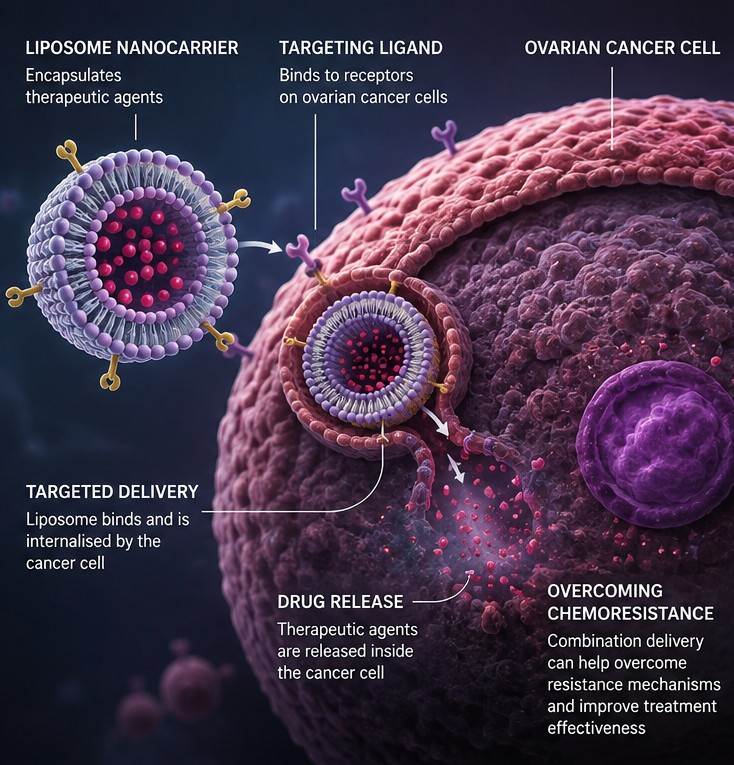
Liposomes are microscopic carriers that can hold medicines. Researchers are studying ways to use them to deliver treatment more selectively to cancer cells.
Prof Goh said promising laboratory findings are only one part of developing a treatment that patients can use.
“A promising result in the laboratory is an important first step, but it is not the final measure of success. For nanomedicine to make a meaningful difference to patients, we need to understand how these systems perform in complex human disease and whether they can be manufactured, scaled and delivered safely and consistently.”
The review also considers how researchers might identify patients most likely to benefit from a particular treatment. Studying tumour characteristics, along with medical imaging, could help guide future research. These approaches still need testing to establish their usefulness in clinical care.
Making a liposome more sophisticated can bring further challenges. Added features may make it harder to produce the same formulation consistently and in sufficient quantities. New treatments must also meet safety and regulatory requirements.
These hurdles help explain why many approaches that perform well in laboratory and animal studies have yet to gain strong clinical evidence. The review identifies pegylated liposomal doxorubicin as the liposomal formulation with consistent evidence from phase II and III clinical trials in ovarian cancer. Newer designs need further testing to determine whether they improve patient outcomes.
“The future of nanomedicine will depend not only on scientific innovation, but also on collaboration between researchers, clinicians, manufacturers and regulators. We need to develop technologies that are not only effective in controlled research settings, but also reproducible, scalable and relevant to the patients who need them,” said Prof Goh.
The next question is which of these newer approaches can clearly benefit patients and be produced reliably enough for clinical use. By examining both the research and the barriers to applying it, the review helps point to where further work is needed.