For most people, walking through a dark room or along a poorly lit street is a minor inconvenience. For those living with night blindness or retinitis pigmentosa, however, limited visibility can make everyday movement more difficult and increase the risk of accidents.

Prof. Dr. Malathy Batulamalay (left) from the Faculty of Data Science, INTI International University, along with her Master’s in Information Technology student Shaheer Hussain Qazi (right) developed research titled Smart Night-Vision Glasses with AI and Sensor Technology for Night Blindness and Retinitis Pigmentosa.
This challenge led Prof. Dr Malathy Batulamalay, a Professor at the Faculty of Data Science and Information Technology, INTI International University, and Shaheer Hussain Qazi, a master’s student in Information Technology, to explore whether artificial intelligence and sensor technology could offer another form of assistance.
Their study, titled “Smart Night-Vision Glasses with AI and Sensor Technology for Night Blindness and Retinitis Pigmentosa,” was published in the International Journal of Advanced Computer Science and Applications in 2025. It presents a concept for smart glasses that could help users identify objects and obstacles in low-light or completely dark environments.
The glasses would combine Light Detection and Ranging (LiDAR), infrared, and ultrasonic sensors, each gathering different information. LiDAR works like an invisible measuring tape, using laser pulses to determine the distance and position of nearby objects. Infrared would help detect heat-emitting objects such as people, while ultrasonic sensors would provide further information about obstacles.
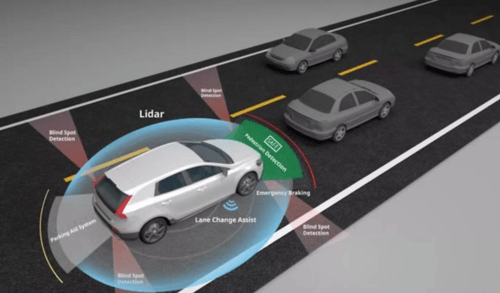
An example of how LiDAR technology is used in self-driving vehicles to measure the distance and position of surrounding objects.
AI would then process the collected data and turn it into a simplified, high-contrast view. Instead of presenting a complicated or highly detailed image, the system would use clear outlines to make objects easier to distinguish. The study compares the effect to the bold outlines commonly seen in cartoons and video games.
“We wanted to explore how different technologies could work together to make it easier for people with night blindness or Retinitis Pigmentosa to understand what is around them,” said Prof Dr Malathy.
The researchers also considered how the glasses might fit into everyday life. They are intended to resemble conventional prescription eyewear rather than bulky specialist equipment, with users able to switch between normal and night-vision modes when they need additional assistance.
This emphasis on usability addresses some limitations in existing assistive devices. Smart glasses that depend heavily on cameras and ambient light may be less effective in darkness. At the same time, those that provide audio instructions could interfere with a user’s awareness of traffic and other important sounds. Size, cost, battery life, and privacy may also affect whether users can wear and use these devices comfortably and regularly.
To reduce dependence on an internet connection, the study explores edge AI, which would process data within the glasses rather than through an external cloud system. This could reduce delays and allow the device to function in places where internet access is unavailable.
The paper uses familiar situations to illustrate how the technology might work. On a dimly lit staircase, for example, the edges of the steps and nearby furniture could be highlighted. On a pavement, broken sections and kerbs could be outlined to help users recognise possible tripping hazards.
At this stage, however, the glasses remain a research concept rather than a completed product. Producing a functional wearable device would require further development in areas such as sensor size, battery consumption and the speed at which large amounts of data can be processed.
The researchers propose using virtual simulations and controlled trials with functional prototypes as the next stage. Feedback from people with visual impairments would be especially important in refining features such as contrast, object clarity, outline thickness and depth sensitivity.
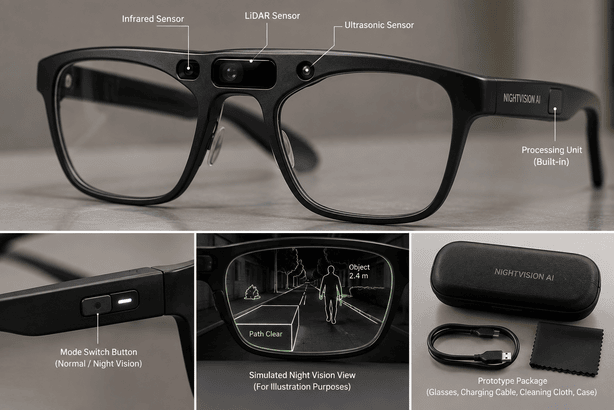
A conceptual visualisation of smart glasses that would combine LiDAR, infrared and ultrasonic sensors with AI processing to help users navigate low-light environments.
“The concept is only the starting point. Before something like this can be used in everyday life, it would need to be tested carefully with users and refined based on their experiences,” said Prof Dr Malathy.
Rather than presenting a finished solution, the study offers a possible direction for future development by combining AI with several forms of sensor technology to make objects and hazards easier to distinguish in low light.