Brain drain, artificial intelligence, global trade tensions, and the future of work are no longer distant policy debates. For several students from INTI International College Penang (IICP), these issues became the focus of their award-winning analyses at the AMEU Economics Essay Competition. This national-level platform brought together university students from across Malaysia to examine challenges affecting the country’s workforce, economy, and development.
(From left) Louis Chin Yi Chun, Dr Sheila Rose Darmaraj, and Katrina Tan Jo-Anne celebrate their achievements at the AMEU Economics Essay Competition, where INTI International College Penang students gained national recognition for their analyses on Malaysia’s brain drain, global trade tensions, and the future workforce in the age of AI.
Students from different academic backgrounds were recognised for essays on talent retention, global trade tensions, automation, and workforce transformation.
Among them was Katrina Tan Jo-Anne, a Bachelor of Business (Accounting) student pursuing the 3+0 programme in collaboration with Swinburne University of Technology, Australia, who emerged as Second Runner-Up.
Katrina said the competition allowed her to explore economic issues beyond classroom learning while strengthening her research and analytical skills. Her essay looked at Malaysia’s manufacturi
ng and export strategies amid rising global trade tensions and shifting supply chains.
“Having awareness of these issues helps students stay informed, relevant, and better prepared as future workers and decision-makers,” she said.
For Louis Chin Yi Chun, a student from the Centre for American Degree Programmes (CADP), the competition became an opportunity to examine Malaysia’s ongoing challenge in retaining talent.

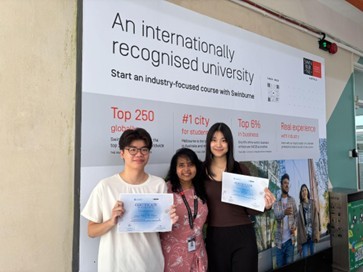
(From left) Kathrine Tan, Student Affairs Officer, and Teh Xin Wei, a Bachelor of Arts in Psychology student from INTI International College Penang, pictured with the certificate received at the AMEU Economics Essay Competition.
“Malaysia invests a huge amount of resources into international scholarship programmes to build up our human capital. If we do not have the right infrastructure to bring these scholars back, then we are not just losing talent, but we are also actively supporting the economies of competing countries,” he said.
Louis added that while Malaysia produces highly skilled and globally competitive graduates, industries must continue to evolve into high-value, innovation-driven sectors capable of retaining talent locally.
He also stressed the growing importance of human judgment in an increasingly AI-driven world.
“Critical thinking helps us understand complex and connected global issues by identifying their root causes, and it provides the human judgment that AI and data alone cannot give,” he said.
Another CADP student, Leong Kit Yee, also examined Malaysia’s brain drain issue, noting that the competition helped her better understand the problem-solving skills needed in an evolving workforce.
For Teh Xin Wei, a student pursuing the Bachelor of Arts in Psychology (4+0) programme in collaboration with Southern New Hampshire University, the competition showed how economic issues are closely connected to communities and daily life.
“I realised that economic problems are connected to people’s daily lives. Issues like inflation, unemployment, and the digital divide can affect businesses, students, and families,” she said.
Coming from a psychology background, Xin Wei examined how policies and economic changes influence human behaviour, emotions, and decision-making.
Senior Lecturer from the Centre for American Degree Programmes, Dr Sheila Rose Darmaraj, said the competition showed why students need learning experiences that cut across disciplines and connect with real issues. “Students engage in deep learning when they are challenged to think, to question, and apply,” she said.
Chief Executive of INTI International College Penang, Hemalatha Murugiah, said the students’ achievements were meaningful because they showed a willingness to think seriously about issues that matter to Malaysia.
“Brain drain, artificial intelligence, global trade shifts, and the future of work are not distant topics.
These are issues our students will face as they enter the workforce, build their careers, and make decisions that affect the communities around them,” she said.
“It is encouraging to see students from different fields bringing their own perspectives to national conversations. For us, this is an important part of education. We want our students to be curious, thoughtful, and confident enough to ask good questions, not just look for quick answers.”