Artificial intelligence is making it easier to create convincing fake videos, cloned voices and manipulated images. From financial scams and identity fraud to viral misinformation, the challenge is no longer only what AI can create, but how people can tell what is real.
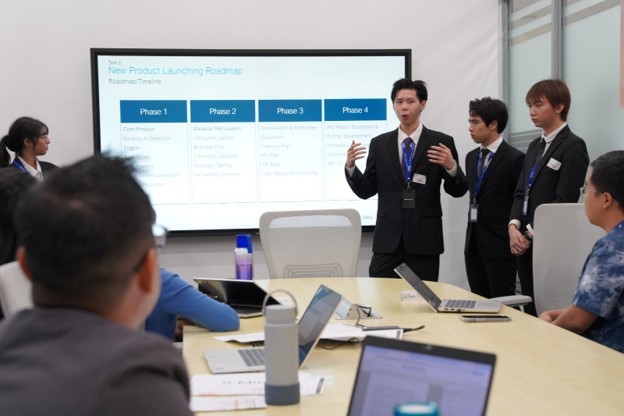
Darius Goh Wey Li (centre) and his teammates present Veri.AI to the judging panel during the Dell Business Challenge 2026 finals. The team’s proposed AI-powered verification platform earned First Runner-Up, while Darius received the Best Presenter Award.
For five students from INTI International University, that concern became the starting point for Veri.AI, a proposed AI-powered verification platform designed to help detect deepfakes, manipulated images, cloned voices and suspicious documents.
The idea earned the team First Runner-Up at the Dell Business Challenge 2026, while team leader Darius Goh Wey Li received the Best Presenter Award for communicating the solution with clarity and confidence.
The team comprised Darius, Muar Jun Wei, Renee Tham Kai Yan and Gursimranjit Kaur A/P Gurjit Singh, who are pursuing the Bachelor of Arts (Hons) Accounting and Finance 3+0 in collaboration with the University of Hertfordshire, UK, and Tan Cheng Li Ji, who is pursuing the Bachelor of Business (Finance) 3+0 in collaboration with Swinburne University of Technology, Australia.
Held on 10 June 2026 at the Dell Global Business Center in Bayan Lepas, Penang, the Dell Business Challenge brought together university students from across Malaysia to solve real business problems and present their recommendations to Dell executives.
After analysing Dell’s AI market performance across the Asia-Pacific region in the preliminary round, the INTI team advanced to the finals as one of the top eight teams. In the final round, they received a new case study. They had only three hours to analyse the problem, develop a commercial AI product concept, prepare a presentation and pitch their solution to industry judges.
As the team examined the case, one issue stood out: the rapid rise of deepfake scams and AI-generated misinformation.
“We have seen scammers impersonate CEOs to request urgent bank transfers, fake celebrities promoting fraudulent investment schemes, manipulated documents used to deceive companies, and AI-generated videos spreading misinformation across social media platforms,” said Darius. “The technology has advanced to a point where even trained professionals struggle to identify what is real.”
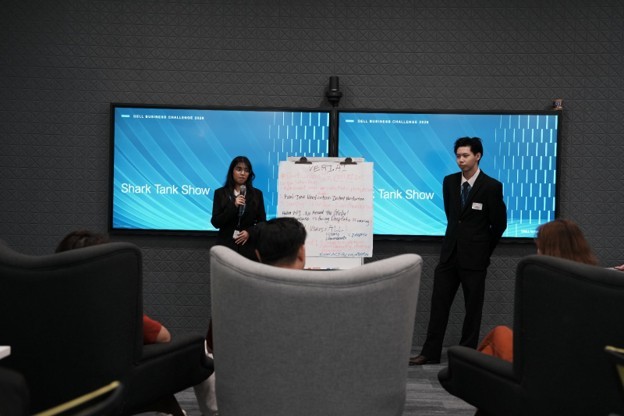
Gursimranjit Kaur A/P Gurjit Singh (left) and Darius Goh Wey Li pitch Veri.AI during the Shark Tank session of the Dell Business Challenge 2026 finals. The INTI team presented its proposed deepfake detection and identity verification platform to a panel of Dell directors, the organising committee and fellow finalists.
That observation shaped Veri.AI, which the students positioned as a verification platform for organisations that need to assess whether digital content can be trusted.
“Most AI products today are built to create content, to generate images, clone voices and produce videos,” Darius explained. “Veri.AI flips that entirely. Instead of using AI to produce more content, we used AI to question content.”
In the team’s concept, users would upload an image, video, audio recording or document to Veri.AI. The platform would then analyse signs of manipulation before generating a unified Trust Score to indicate whether the content is likely to be authentic, suspicious or in need of further verification.
Rather than requiring organisations to use different tools for different formats, Veri.AI was designed to bring these checks together under one system. The students proposed it as a practical tool for businesses, financial institutions, media teams and public-facing organisations that may need to verify digital content quickly before acting on it.
The proposal also had to make commercial sense. The students positioned Veri.AI as a decision-support tool for organisations facing suspicious digital content, such as urgent voice instructions, payment requests, video statements, social media posts or documents.
By combining multiple checks into one Trust Score, the team proposed a system that could help reduce uncertainty in situations where false or manipulated content may lead to financial loss, reputational damage or public confusion.
The team also tailored the concept for the Asia-Pacific market, taking into account local regulations, languages and regional fraud patterns that may not always be fully addressed by tools developed for other markets.
For Darius, the judges’ response showed that the idea resonated because it was tied to a problem people are already encountering in everyday digital spaces.
“Deepfake scams are a growing concern that people encounter on platforms like TikTok, Instagram and YouTube,” he said. “Rather than treating AI purely as a tool for creation, we proposed using it as a tool for protection. That angle, using AI to defend people from AI, connected with the judges because it addressed something real and urgent.”
His presentation approach also played a role in the team’s success.
“I wanted the judges to feel the relevance of the problem before we even presented the solution,” Darius said. “Instead of relying on technical jargon, I explained the concepts through real-world examples that everyone in the room could relate to.”
The team also had to learn how to work together under pressure. Its members came from different academic years and programmes, and some had not worked together before the competition. Conflicting class schedules made it difficult to meet regularly, so they relied on online meetings, weekend practice sessions and continuous discussions to understand one another’s strengths.
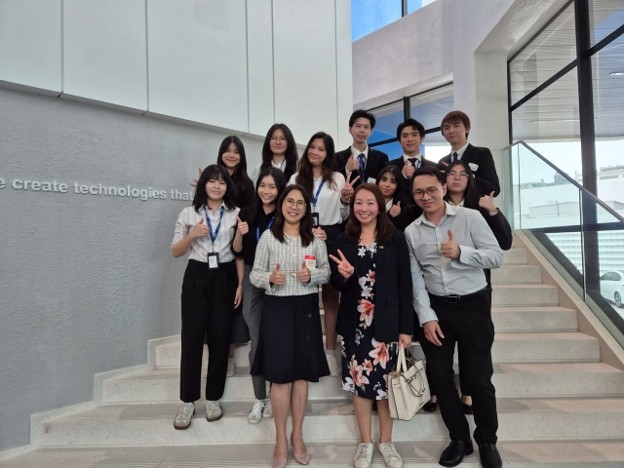
The two INTI International University teams that advanced to the Dell Business Challenge 2026 finals are pictured at the Dell Global Business Center in Bayan Lepas, Penang.
“By the time we reached the finals, our teamwork felt seamless,” said Darius. “That cohesion was a big part of how we were able to complete everything within three hours and still perform well under pressure.”
Developed within a three-hour competition challenge, Veri.AI addressed a problem that extends far beyond the judging room. As artificial intelligence becomes more powerful and accessible, digital trust will depend not only on what AI can create, but on how people and organisations verify what is real