Speaking English in front of an audience can be daunting, especially for students who are still building confidence in the language.

Suganiya Nilamegan, Programme Director of IEP Spotlight: Speak, Act, Shine, said drama gave students repeated opportunities to practise English, work with their peers and gradually become more confident speaking in front of others.
Tashiro Yuzuki, a Semester 3 Bachelor of Business (Honours) International Business student at INTI International University, experienced this firsthand while preparing for IEP Spotlight: Speak, Act, Shine, an English drama talent competition held on 2 October 2026.
He spent time understanding his script, working on his pronunciation and rehearsing with four fellow Japanese students, with the group helping one another through difficult lines and encouraging each other throughout the preparation process.
“I was a little nervous because I was worried about making mistakes, but after practising and performing, I became more comfortable,” he said.
“It showed me that I can speak English in front of others even though I am still learning.”
Yuzuki was among 160 students from INTI International University’s Intensive English Programme (IEP) who took part in the competition, which was designed for students at beginner to lower-intermediate English proficiency levels.

Tashiro Yuzuki (third from left) rehearsed with his teammates for IEP Spotlight: Speak, Act, Shine, where students used drama to practise pronunciation, communication, and teamwork.
Rather than relying only on written exercises and classroom discussions, the programme gave students a chance to use English through performance. In groups, they worked on scripts, pronunciation and delivery, while learning to respond to one another and communicate with an audience.
Suganiya Nilamegan, Programme Director of IEP Spotlight: Speak, Act, Shine, said they chose drama because it gives students a reason to use English in a more interactive setting.
“When students perform, they have a purpose. They play a character, tell a story, and communicate with their audience. This makes English more meaningful and, hopefully, less intimidating,” she said.
The preparation was as important as the final performance. With guidance from their lecturers, students had to understand their scripts, practise repeatedly and work through difficult lines together.
Suganiya said confidence can sometimes be as much of a barrier as language ability.
“Some students actually know more English than they think they do, but they are afraid of making mistakes, being judged by their classmates, or not pronouncing something correctly,” she said.
“That is why activities like drama are useful. Students get repeated opportunities to practise the same language, work with their friends, and gradually become more comfortable speaking English in front of others.”
Practising with teammates also gave Yuzuki more opportunities to use English and interact with others.
“What I enjoyed most was having the opportunity to speak English with other students and have fun together. We could practise our English while also getting to know each other better,” he said.
“It was nice to be able to communicate with students from different backgrounds, even though we are all still learning.”
The group-based format also meant students had to listen to one another, divide responsibilities, and ensure each person played a part in bringing the performance together.
Dr Rabindra Dev Prasad, Dean of the Faculty of Education and Liberal Arts at INTI International University, said the experience was part of helping students prepare for the next stage of their studies.
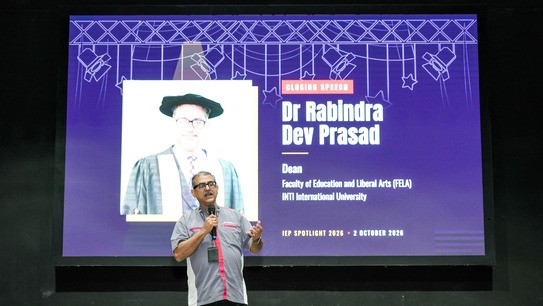
Dr Rabindra Dev Prasad, Dean of INTI International University’s Faculty of Education and Liberal Arts, encouraged students to keep practising their English as they prepare to progress into their mainstream academic programmes.
In his closing remarks, he encouraged students to keep using English and not allow the fear of making mistakes to stop them from communicating. He also highlighted the importance of stronger English proficiency as students progress from the IEP into their mainstream academic programmes.
The programme’s success was not measured only by the final performances or winning performances.
Suganiya said seeing students who were initially hesitant take to the stage, speak before an audience and support their teammates showed the value of giving students repeated opportunities to use the language in a practical setting.
Yuzuki left the competition with a simple piece of advice for other English learners.
“Don’t be afraid of making mistakes. Just try to speak English. If you make a mistake, you can learn from it and try again,” he said.
“The more you practise, the more confident you can become.”