AI systems can help analyse medical images, but some require substantial memory and processing power to perform well. In healthcare and research settings where access to high-end computing resources is limited, this can become a practical barrier.

Prof Dr Asokan Vasudevan, Professor at the Faculty of Business and Communication, INTI International University, was involved in a study exploring whether a smaller AI model could identify different levels of Alzheimer’s-related dementia from MRI scans while using substantially less computer memory.
A study involving Prof Dr Asokan Vasudevan, Professor at the Faculty of Business and Communication, INTI International University, explored whether an AI model could identify different levels of Alzheimer’s-related dementia from MRI scans while using far fewer computing resources.
Published in Scientific Reports, the study, “Alzheimer’s related dementia severity classification from magnetic resonance imaging using derivative-free optimisation of convolutional neural network,” introduced an AI model called DAPA-CNN, designed to classify magnetic resonance imaging (MRI) scans into four groups: no dementia, very mild dementia, mild dementia and moderate dementia.
Because Alzheimer’s-related changes can affect brain structure, clinicians use MRI scans when assessing patients. The researchers wanted to see whether AI could distinguish between different dementia severity levels from these images without relying on a particularly large or demanding model.
DAPA-CNN achieved 99.59% accuracy on one Alzheimer’s dataset, compared with 93.90% for the comparison model. On a separate dataset, it achieved 93.70% accuracy, compared with 87.23%.
“We wanted to explore whether an AI model could distinguish between different stages of dementia without requiring the computing resources associated with more complex models,” said Prof Asokan.
“The results suggest that it is possible to improve classification performance while making the model considerably smaller.”
That reduction was substantial. DAPA-CNN was 85.6% smaller than the comparison model and used 76.6% less memory, with requirements dropping from 1.5 gigabytes to 0.35 gigabytes. Training time was also reduced from 35 minutes to 20 minutes under the study’s testing conditions.
A smaller model could therefore run more easily on computers with more modest specifications, which may be useful in settings where access to powerful computing infrastructure is limited. However, the study did not test DAPA-CNN in routine hospital practice or measure actual cost savings.
The researchers also had to account for an imbalance in the training data, as some dementia stages appeared more often than others. This can make it harder for an AI model to consistently recognise less common stages.
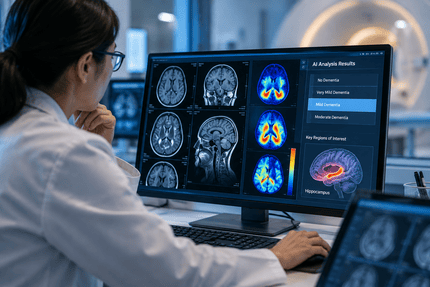
The DAPA-CNN model can highlight which areas of a brain scan influenced its classification, giving clinicians additional information to consider alongside other clinical findings.
To address this, the team adjusted the training data so the model could learn more evenly from the four categories. The results showed improvements not only in overall accuracy, but also in how well the model identified and distinguished between the different categories within the datasets tested.
The study also examined whether the model could indicate why it reached a particular classification.
DAPA-CNN can highlight the parts of a brain scan that influenced its decision. In the study, areas linked to memory were highlighted more often in milder dementia categories, while broader brain regions appeared in moderate dementia cases. These patterns were consistent with known structural changes linked to Alzheimer’s disease, although the highlighted areas do not confirm a diagnosis on their own.
“High accuracy is important, but it is equally important to understand what influences an AI model’s predictions,” said Prof Asokan.
“By highlighting the areas of a brain scan that contribute to its classification, we can give clinicians more information to examine when evaluating the model’s results.”
DAPA-CNN remains a research model and is not yet a diagnostic tool for routine clinical use. Further testing in real healthcare settings and across different patient groups is needed before researchers can establish its reliability in practice.
If future research confirms its performance, models such as DAPA-CNN could help make AI-assisted brain scan analysis more practical in settings with limited computing resources, while keeping healthcare professionals at the centre of diagnosis and patient care.