Worri thinks too much about what might happen next. Bogg worries about looking presentable. Scrolly doesn’t want to miss the latest trend, Pinki feels awkward around others, and Loong can turn a small health concern into something much bigger in his head.
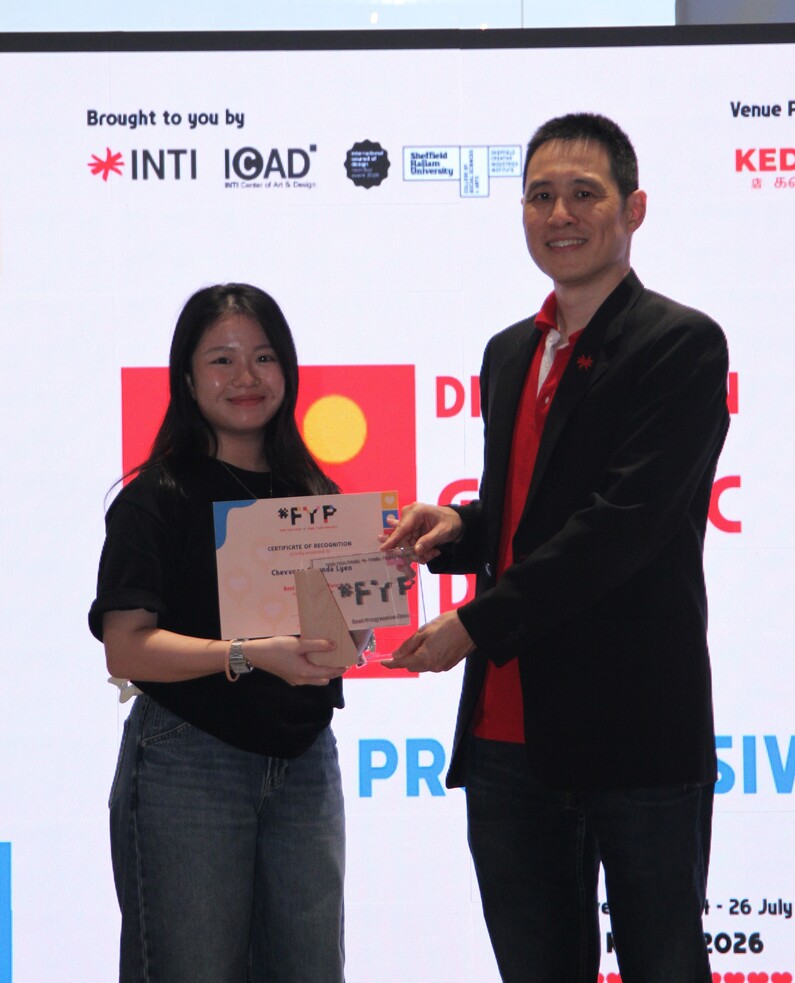
Chevvone Amanda Lyen receives the Best Progressive Design award at the ICAD Graduation Show 2026 for her final-year project, SCARE SMOK?!.
Together, the five cats form the cast of SCARE SMOK?!, a board game created by Chevvone Amanda Lyen, a Diploma in Graphic Design student at INTI International College Subang.
Chevvone developed the game as her final-year project after becoming interested in how worry and anxiety can appear differently from person to person. The project received the Best Progressive Design award at the ICAD Graduation Show 2026, where graduating students from the INTI Centre of Art & Design (ICAD) presented their work.
Before designing the characters or the board, Chevvone surveyed friends and cousins about their experiences. Common concerns included overthinking, FOMO, social pressure, health worries, and appearance concerns.
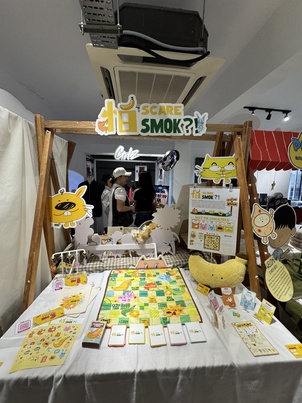
Chevvone’s SCARE SMOK?! exhibition booth brings together the board game, character illustrations, challenge cards and merchandise developed as part of her final-year graphic design project.
Those responses became the basis for Worri, Bogg, Scrolly, Pinki and Loong.
“These characters are an important part of the game, not just its visual identity,” said Chevvone. “Each character represents a different type of anxiety and has a personality based on how that anxiety may appear in everyday life.”
The characters also shape the gameplay. Each comes with 10 challenge cards, while players move around the board by rolling a die and responding to prompts when they land on selected spaces.
The activities range from taking a deep breath and answering a fun question to sharing a personal experience or completing a short activity with other players. The game continues until a player reaches the 100th step.
Chevvone wanted the subject to feel approachable rather than intimidating, so she used humour, colourful illustrations and familiar game mechanics. Snakes and Ladders inspired the basic structure, but she reworked the format around her own characters, anxiety-related spaces and challenge cards.
Traditional ladders became banana slides, one of several visual details that grew out of Chevvone’s use of language and wordplay.
For the colour palette, she looked at the Chinese word “焦虑” (jiāo lǜ), meaning anxiety. She associated “焦” (jiāo) with “蕉” (jiāo), meaning banana, which inspired the use of yellow, while “虑” (lǜ) reminded her of “绿” (lǜ), meaning green. Brown was added to complete the palette used across the game.
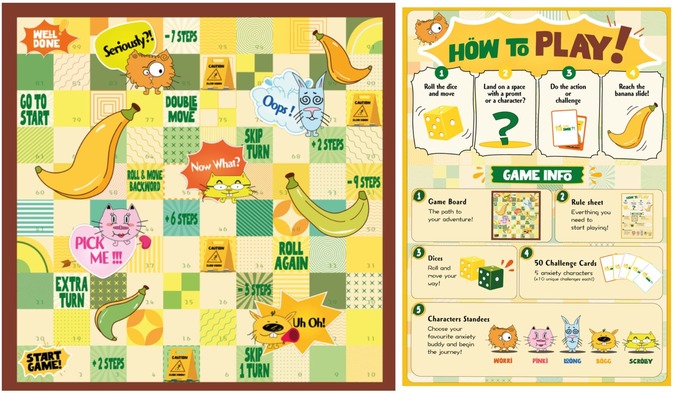
The SCARE SMOK?! board game features five cat characters inspired by different everyday worries, with challenge cards and game mechanics built around their personalities.
The title developed similarly. “SMOK” comes from the Malaysian slang use of the Chinese word “什麼” (shénme), meaning “what”. Chevvone linked it to the way people can overthink and imagine negative outcomes, leaving them to ask what they are actually afraid of.
As the project developed, she had to make sure the different elements worked together. The characters, board, challenge cards, rules sheet, and packaging formed one visual system, while plush toys, stickers, and keychains extended the project into physical merchandise sold during the graduation exhibition.
That meant moving between research, illustration, character development, gameplay, packaging and product design rather than producing a single graphic outcome.
“Receiving the award was a really meaningful moment for me because SCARE SMOK?! was a project that I put a lot of time, research and personal effort into,” she said.
“From developing the concept and characters to designing the board game, cards, packaging and merchandise, I first had to consider whether the idea would actually work.”
The development process involved repeated refinement, particularly in shaping the characters and working through practical design challenges as the game took form.
“As a final-year student, receiving this recognition made me feel incredibly happy and proud,” Chevvone said. “It showed me that the idea I developed could connect with people and encouraged me to continue improving my creativity and design abilities.”
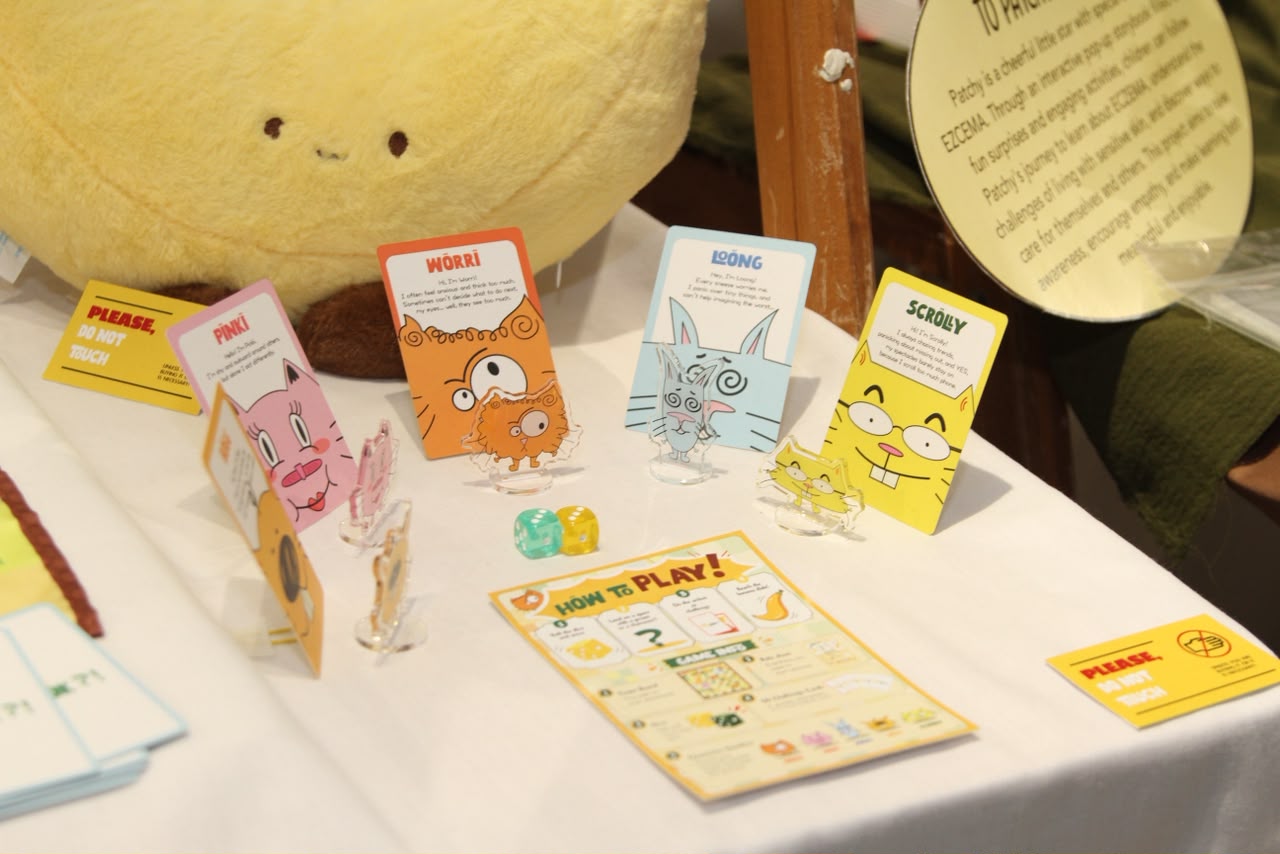
Character pieces, dice and game guides form part of Chevvone’s SCARE SMOK?! project, which extends from the board game to its packaging and supporting materials.
What began as an exploration of familiar worries eventually became a complete interactive design project that people could pick up, play and respond to.
SCARE SMOK?! does not try to solve anxiety. Instead, Chevvone used design to turn experiences that can sometimes be difficult to talk about into characters, prompts and moments around a game table.