A student can ask AI to explain a difficult idea or help them start an assignment in seconds. What happens after they receive that answer matters too. Do they examine it, question it and work out how to use it?
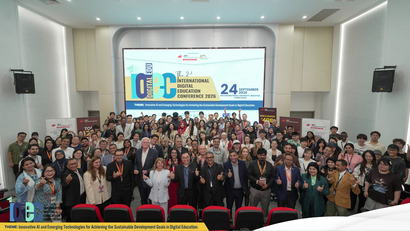
Researchers and educators from 17 higher education institutions came together at IDEC 2026 to discuss the future of digital education across five conference tracks.
That concern drove a study discussed at the International Digital Education Conference (IDEC) 2026, organised by INTI International University. Its findings painted a more complicated picture of AI use, with greater reported reliance on generative AI linked to stronger reported learning outcomes.
The study, titled “The Impact of Generative AI Dependency on Learning Outcomes: The Mediating Role of Cognitive Agility among University Students,” examined students’ reliance on AI alongside their cognitive agility and reported learning outcomes. Dr Sehrish Khalid of the University of Lahore, Pakistan, authored the research.
The study was prompted by the growing use of generative AI among university students for tasks such as searching for information, completing academic work and solving problems. While these tools can provide quick access to information and learning support, their increasing use has also raised questions about whether students may become too dependent on them.
Cognitive agility is the ability to adjust one’s thinking when faced with new information or an unfamiliar problem. It is relevant when a student receives an AI-generated answer but still needs to judge whether it makes sense and how it applies to the task at hand.
“The particular interest was understanding whether students’ cognitive agility could help explain the relationship between AI use and learning outcomes,” Dr Khalid said.
The researchers surveyed 400 university students. Those who reported greater reliance on generative AI also tended to report higher cognitive agility and better learning outcomes.

A study involving Dr Sehrish Khalid from the University of Lahore, Pakistan, examined how university students’ reliance on generative AI relates to their cognitive agility and reported learning outcomes.
The findings also showed a strong relationship between cognitive agility and learning outcomes, suggesting that how students process and respond to information may be an important part of understanding AI’s role in learning.
The results do not show that AI improved students’ thinking or learning. The survey recorded students’ responses at one point in time, so it cannot establish cause and effect. It does, however, suggest that discussions about AI in education need to consider not only how often students use these tools, but also how they engage with the information they receive.
Dr Khalid said universities have a role in helping students build that ability.
“Universities should focus not simply on increasing or restricting students’ use of AI, but on helping students develop the skills to use AI critically and responsibly,” she said.
She also suggested AI literacy and professional development opportunities for students and educators, so they can make informed decisions about using these tools in academic work.
“The central consideration should be ensuring that AI supports students’ learning and cognitive development rather than replacing independent thinking,” she added.
The study was among the research presented at IDEC 2026, which brought together researchers and educators from 17 higher education institutions. Held under the theme “Innovative AI and Emerging Technologies for Achieving the Sustainable Development Goals in Digital Education,” the conference explored AI, learning analytics and immersive technologies such as augmented reality, virtual reality and extended reality across five conference tracks.
The wider discussions also considered how emerging technologies can support personalised and adaptive learning, improve learner engagement and create more interactive learning environments.
INTI International University Pro Vice-Chancellor (Research and Innovation), Prof. Ts. Dr Wong Ling Shing, said the conference placed those discussions within a wider view of education.

IDEC 2026 brought participants together to discuss AI, learning analytics and immersive technologies in education.
“The conference aims not to discuss education in isolation but to explore its fundamental role as the engine for sustainable development.”
For educators deciding how AI fits into their classrooms, the study points to a practical task: helping students use the assistance available to them while continuing to develop the judgement to question, evaluate and think through an answer for themselves.