An action that may appear small to others can represent an important milestone for a child with a disability and their family.
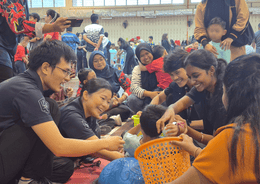
INTI physiotherapy students worked in groups to develop and facilitate activities designed to support movement, balance, gross and fine motor skills, and confidence among children taking part in the RYTHM Programme.
That understanding was at the heart of the RYTHM (Rhythm of Harmonious Living) Programme, in which physiotherapy students from INTI International University’s Faculty of Health and Life Sciences worked with children with disabilities through therapeutic games and activities tailored to their physical and cognitive needs.
Led by FHLS lecturer Hema Shangkari Poobalan, the students worked with their lecturers to design adaptive activities focusing on movement, balance, gross and fine motor skills, and confidence. The challenge was not only to plan the activities but also to adjust them based on how each child responded.
Hema said learning to adapt and communicate with children with different needs was an important part of the experience.
“Most importantly, I hope they learned how to communicate and work patiently with children with different needs,” she said.
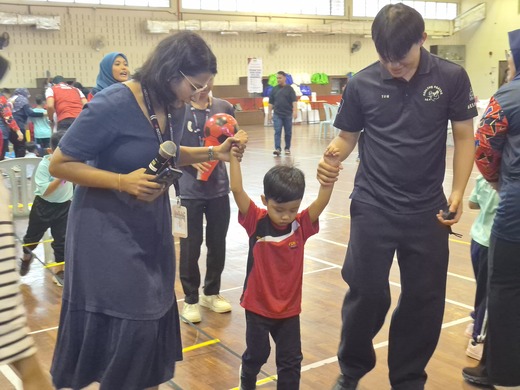
Programme leader and FHLS lecturer Hema Shangkari Poobalan (left) guided students as they adapted activities to the children’s different needs during the programme.
Koh Wee Ler, a sixth-semester Bachelor of Science (Honours) in Physiotherapy student at INTI, said the experience showed him how different direct interaction could be from what he had expected.
He was nervous at first because it was his first time interacting with children with disabilities and soon realised that communicating with them required him to change his usual approach.
“You can’t just speak in a complex way like how we normally speak,” Wee Ler said. “We need to speak in a simpler form, in a simpler manner. We also need to be more playful because they’re kids. We need to be patient as well. That’s the most important thing.”
Working with the children gave the students a chance to see how adjustments in communication and activity design could help them respond to different needs during the programme.
The RYTHM Programme forms part of the OKU Therapy Programme, a volunteer-based community engagement initiative under the 2026 National Budget of the Ministry of Women, Family and Community Development (KPWKM), in collaboration with the Social Welfare Department (JKM), Ministry of Youth and Sports (KBS), and Ministry of Higher Education (KPT).
The students’ efforts were acknowledged by YB Siti Nur Umaira binti Hasim, the Chairman of the Women, Family and Community Development Action Committee for Negeri Sembilan and the State Assemblywoman for Labu, who highlighted the importance of collaboration among the State Government, JKM, and higher education institutions such as INTI.
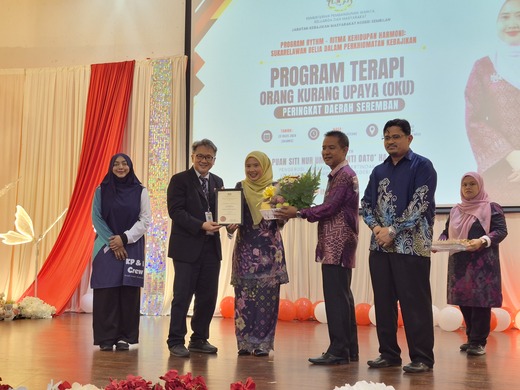
YB Siti Nur Umaira binti Hasim, Chairman of the Women, Family and Community Development Action Committee for Negeri Sembilan and State Assemblywoman for Labu, highlighted the importance of collaboration between the State Government, the Social Welfare Department, and higher education institutions in supporting children with disabilities and their families.
“I am very encouraged to see the close collaboration between the Negeri Sembilan Social Welfare Department and INTI International University, where the expertise of lecturers and the contributions of physiotherapy students and the Faculty of Health and Life Sciences are helping to deliver today’s therapy programme,” she said. “More importantly, this collaboration reminds us that supporting the OKU community requires a professional, holistic and compassionate approach.”
She added that seemingly small achievements could carry much greater significance for children with disabilities and their families.
“Through today’s activities, our children are not only strengthening their physical abilities, but also stimulating their cognitive development, improving their gross and fine motor skills, and building their confidence,” she said.
“When a child with a disability is able to accomplish something independently, no matter how small, it represents a significant victory for their parents and caregivers.”