Artificial intelligence is often associated with large datasets, powerful computing systems and advanced research laboratories. For two Cambridge A-Level students from INTI International College Penang, the challenge was different: how could they train an AI model with limited data?
That question shaped the project by Low Yu Xuan and Yip Yu Foong, who were part of the winning team in the National AI Competition 2026, Computing Track, Pre-University Category, organised by Rakan Tutor and Sunway University.
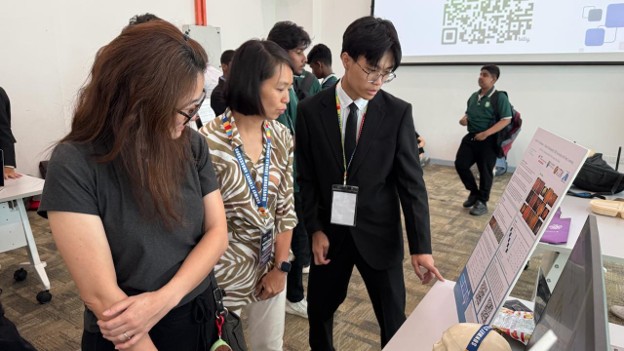
Yip Yu Foong explains the team’s AI approach to visitors, highlighting how they achieved 93% accuracy using limited training data.
Their team developed an AI model to identify different stages of diabetic retinopathy, achieving 93% accuracy and securing the national championship against teams from across Malaysia.
Diabetic retinopathy is a complication of diabetes that can damage the retina, the light-sensitive tissue at the back of the eye. If not detected or treated early, it can affect vision and may lead to blindness. By working on a healthcare-related challenge, the students were able to apply AI and computing concepts to a problem with practical relevance.
What made the project particularly challenging was the amount of data available to them.
Instead of training their model on a large collection of images, the students had to work with a much smaller set provided by the competition organisers. To make better use of the limited material, they carefully prepared and standardised the images before training the model.
They then combined two image-recognition systems, ResNet-34 and EfficientNet-B4, and used another machine-learning method known as Random Forest to make the final classification.
“We wanted our model to achieve the same level of accuracy as existing models while working with limited training data,” said Yu Foong.
Rather than relying on a single system, the team combined different approaches to make better use of the available information.
The process was not straightforward. Some stages of diabetic retinopathy were represented by fewer images than others, which made it harder for the model to learn evenly across all categories. The students also had to work within limited computing resources and a fixed competition timeframe, and some models took longer than expected to finish training.
They later tested the trained model on labelled retinal images from an online dataset, where it correctly classified 93% of the images.
For Yu Xuan and Yu Foong, the project’s potential extends beyond the competition. With further development, they hope a model like this could support preliminary screening in medical facilities before patients are assessed by specialists, helping make the early stages of screening more efficient.
The project also gave the students an opportunity to work with AI at a level that required more than just an understanding of the theory. They had to decide how to use limited resources, compare different approaches, and adjust when the models did not perform as expected.
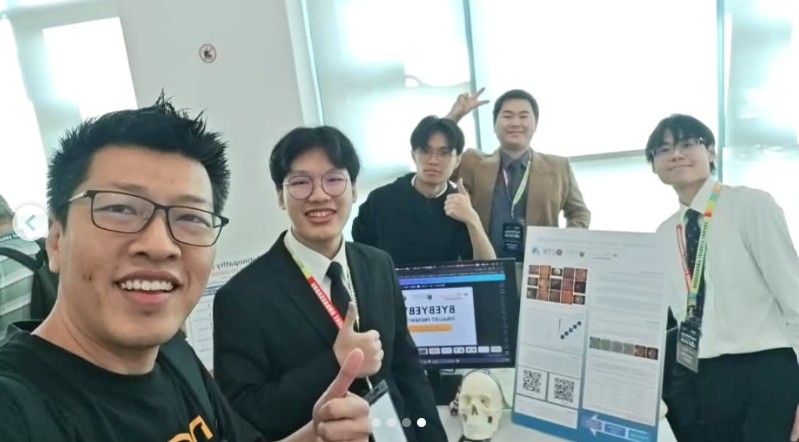
Low Yu Xuan and Yip Yu Foong share a moment with fellow participants and visitors at the National AI Competition 2026.
Outside their studies, both Yu Xuan and Yu Foong also serve in INTIMA, INTI Penang’s Student Government, taking on student leadership responsibilities alongside their academic work.
Their national championship shows what pre-university students can achieve when they are given the opportunity to work on advanced problems with real constraints. Rather than treating limited data as a reason to scale back their ambitions, Yu Xuan and Yu Foong made it the central problem they needed to solve.
The 93% accuracy may be the figure that draws attention, but the more important part of the project was how they achieved it: by carefully preparing the available data, combining different AI methods, and learning to make better use of the resources they had.
Sometimes, doing more begins with learning how to work with less