When Low Yu Xuan and Chon Feng Qi prepared for the 2026 International Olympiad in Artificial Intelligence (IOAI), much of what they needed to know was not something they could revise from their Cambridge A Level notes. They had to learn it themselves.
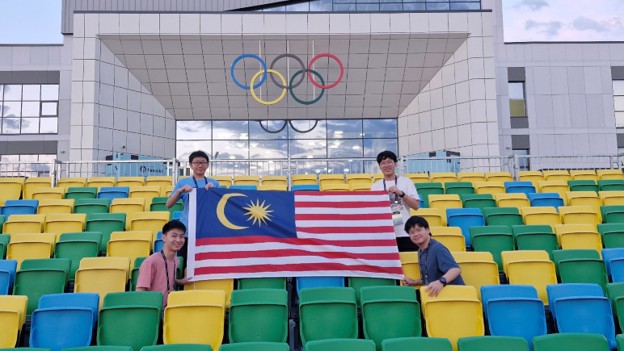
Malaysia’s four-student team, comprising Lee Yan Zee, Low Yu Xuan, Chon Feng Qi and Tan Zen Ee, at the 2026 International Olympiad in Artificial Intelligence in Astana, Kazakhstan. INTI International College Penang students Low and Chon each won an individual Bronze Medal.
The two students from INTI International College Penang eventually represented Malaysia at the international competition in Astana, Kazakhstan, where each won an individual Bronze Medal. Held from 2 to 8 August 2026, IOAI brought together more than 400 young participants from 108 countries and territories. Low and Chon were part of Malaysia’s four-student team, together with Lee Yan Zee and Tan Zen Ee.
For Chon, reaching that stage followed about two years of learning AI outside his formal studies.
“Basically, none of the IOAI syllabus is covered in Cambridge A Levels, so I had to learn pretty much everything from scratch in my free time,” he said.
He started with online courses and tutorials before moving on to practice through Kaggle and other platforms. At the same time, his A Level studies still had to come first, which became particularly challenging when the Asia Pacific round fell just one week after his examinations.
Chon focused on completing his A Levels before using his remaining time to prepare for AI. Even after that effort, he didn’t expect to qualify for the international round.
Once he did, his approach changed. He didn’t have enough time to study every part of AI in depth, so he focused on strategies and techniques that could help him perform under competition conditions. Looking back, he said he had only managed to “scratch the surface” of the subject, leaving much more that he wanted to explore.
Low had a shorter preparation window of around two to three months, with his own A Level examinations taking priority. Much of his focused preparation therefore began only after his exams were over.
He worked through online resources, tutorials, and problems, including “upsolving”, where he returned to questions after his first attempt to better understand how to solve them. That process helped him become more comfortable with unfamiliar problems, something that proved important in Astana.
At IOAI, participants tackled coding challenges, new problem types, and strict time limits. Low encountered a problem involving an AI approach he had not dealt with before, so he began by looking for techniques from similar problems that might carry across.
“When encountering unfamiliar questions, my first instinct is to recall if there are similar questions in the same domain whose techniques may carry across in the solution,” he said.
“I build a baseline solution first to lock in points before trying out ideas and formulating a solution to solve the problem fully.”
Chon faced a different problem. He could see a possible way forward, but getting his code to work was taking too long. Rather than letting one task consume too much of the competition, he set a limit on how long he would spend debugging before moving on.
“I would debug for a while, but with a strict limit. If I spent a certain amount of time and the code still did not run, I would skip and move on,” he said.
“After I complete other tasks or have a better idea of it, I will then come back to solve it again.”
Their approaches were different, but both had to make decisions under pressure. The competition required more than technical knowledge. It also meant judging when to persist, when to try another approach and when to leave a problem temporarily rather than lose valuable time.
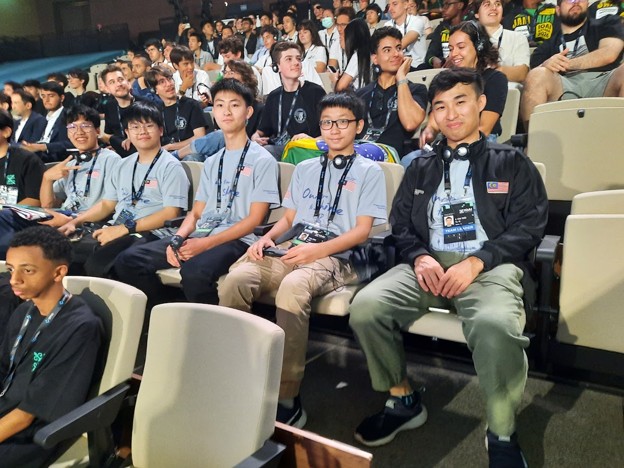
Team Malaysia at the 2026 International Olympiad in Artificial Intelligence in Astana, Kazakhstan, which brought together more than 400 young participants from 108 countries and territories.
When the results were announced, Low said winning Bronze carried particular meaning because he had competed for Malaysia.
“I felt excited when I got bronze. Best feeling when I achieved substantial results for my country,” he said.
Chon had been less certain of the outcome. His score was close to the medal boundary, leaving him nervous as he waited for the results. When his Bronze Medal was confirmed, he credited his parents and coach for supporting him throughout the process.
The experience was not confined to the competition hall either. Chon expected IOAI to feel intense and highly professional throughout, but found that students from different countries readily exchanged ideas, discussed their approaches, and formed friendships while experiencing another culture.
Back home, both students are building on what they learned in Astana. Chon wants to deepen his understanding of AI theory and work on real-world projects, while Low plans to keep applying his coding skills and eventually help train other students