Removing lead from contaminated water is not as simple as passing the water through a filter. A specialised membrane can capture lead, but how well it works depends on several factors, including its composition, the pressure applied, the treatment time, and the amount of lead in the water.
Finding the best combination of these factors can require many laboratory tests. An international team of researchers, including Associate Professor Dr Narinderjit Singh Sawaran Singh, Dean of the Faculty of Data Science and Information Technology at INTI International University, examined whether artificial intelligence could help narrow down the options.

Associate Professor Dr Narinderjit Singh Sawaran Singh, Dean of the Faculty of Data Science and Information Technology at INTI International University, was part of an international research team studying the use of AI-based modelling in wastewater treatment.
The study, titled “Computational Artificial Intelligence Application in UF Membrane Operational Behaviour Assessment for Wastewater Treatment,” used AI-based modelling to predict the performance of a filtration membrane under different conditions.
As contaminated water passes through the membrane, materials within it help capture the lead. Its performance, however, may change when the composition of the membrane, operating pressure, treatment time, or initial lead concentration is adjusted.
“Wastewater treatment processes involve several variables that can influence how well a membrane performs,” said Dr Narinderjit. “By using modelling techniques, we can study the relationships between these variables and predict how the system may respond under different conditions.”
This becomes particularly challenging because the factors do not necessarily work independently. Changing one can affect another, so researchers need to consider combinations rather than examine each factor in isolation.
To make sense of these combinations, the researchers used two modelling approaches.
One was an artificial neural network, a form of AI that learns patterns from data. The model was trained using information about the membrane and its operating conditions, along with performance data recorded under those conditions.
After learning the patterns in the data, the model could predict how the membrane might perform under changed conditions. This provided a way to assess different combinations without testing every possibility individually.
The researchers also used a statistical model to examine the relationships between the factors and identify conditions that could optimise the membrane’s performance.
While the two approaches analysed the information differently, both were intended to help answer the same practical question: which combination of conditions is likely to work best?
In simple terms, the membrane removes lead from water, while the models help researchers determine how to use it more effectively.
The study found that both approaches could predict the membrane’s performance with high accuracy. The artificial neural network performed particularly well at predicting the membrane’s ability to capture lead, while the statistical model accurately described the system’s behaviour.
The researchers also identified combinations of conditions associated with higher water flow through the membrane and a greater capacity to capture lead.
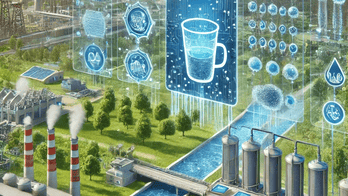
The study used AI-based modelling to predict how changes in membrane composition and operating conditions could affect lead removal from contaminated water.
These findings could help researchers decide which conditions are worth examining further. Instead of spending time and resources testing every possible combination, they could use the models to identify more promising options and focus their laboratory work accordingly.
The models do not, however, replace laboratory testing. Their predictions must still be considered alongside experimental results and tested under different conditions.
“AI-based modelling is a supporting tool rather than a replacement for laboratory work,” Dr Narinderjit said. “The predictions still need to be considered alongside experimental results, and further laboratory testing is needed to assess how the findings can be applied under different conditions.”
The study brings together data science and wastewater treatment to address a practical challenge. By helping researchers understand how several factors interact, AI-based modelling could provide a more focused way to plan experiments and identify where further investigation would be most useful.