Before sunrise at Pantai Kerachut, 24 students from INTI International College Penang stood on the sand and watched ten endangered turtle hatchlings begin their journey to the sea.
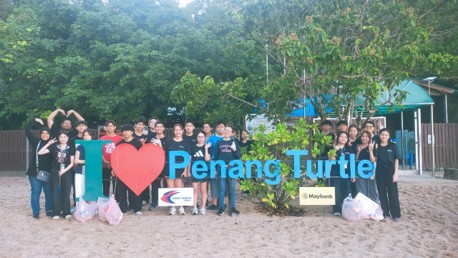
Students from INTI International College Penang at Pantai Kerachut following a marine conservation programme that included a turtle hatchling release, beach clean-up, and environmental education session at Penang National Park.
The hatchlings were small, slow and vulnerable. Later, during a beach clean-up, the students found another part of the story beneath their feet: tiny pieces of plastic buried in the sand.
The visit to Penang National Park was part of a marine conservation programme organised in collaboration with the Department of Fisheries Malaysia and the Pantai Kerachut Turtle Conservation and Information Centre. Students released turtle hatchlings, took part in a beach clean-up and learned from conservation officers about the threats facing Malaysia’s marine biodiversity.
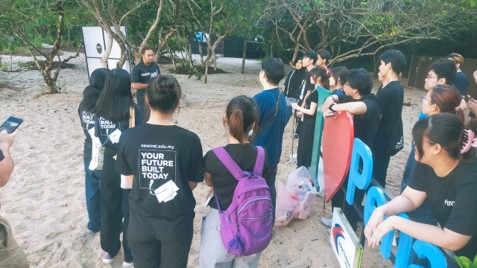
An officer from the Department of Fisheries Malaysia briefs INTI International College Penang students on turtle conservation, nesting patterns, and the importance of protecting Malaysia’s marine biodiversity at the Pantai Kerachut Turtle Conservation and Information Centre.
For Clarance Tan Joey, a Diploma in Finance student, the experience changed the way he understood sustainability.
Before the visit, he said, sustainability felt like “a textbook buzzword”.
“I thought it only meant basic things like recycling plastic or turning off lights without really understanding the real-world impact on nature,” he said.
That changed when he saw how much waste was hidden in the sand.
“I saw how much tiny plastic was buried beneath the sand. It made me realise pollution isn’t just visible rubbish. It is deeply trapped inside the habitats of these animals,” he said.
The hatchling release also stayed with him.
“I felt excited and worried because some of them moved so slowly that I thought they had died,” Clarance said.
For Fergus Yeoh Yong Ming, a School of Business student, the programme showed how many factors can affect the survival of marine life even before the hatchlings reach the ocean.
“Watching everyone carefully release the baby turtles made me realise how vulnerable these creatures are to both natural disasters and human activities,” he said.
He was also surprised by what he learned from the conservation officers, including how the temperature of the sand can influence the gender of turtle hatchlings, and how light pollution from nearby developments can cause them to move away from the sea.
The experience has since changed some of his own habits.
“I now avoid single-use food packaging by bringing my own container. I also choose public transport whenever possible and reduce my electricity consumption by limiting my air-conditioning use,” Fergus said.
Diploma in Business student Yeoh Zhihan said seeing the hatchlings up close made the issue feel more immediate.
“When I saw how small and weak the baby turtles were, it suddenly felt very real compared to simply learning about sustainability in class,” he said.
Since returning from the programme, Zhihan has become more conscious about reducing plastic waste and disposing of rubbish responsibly.
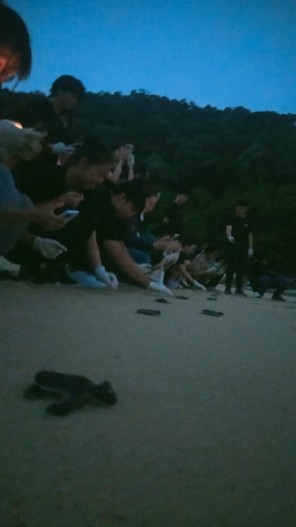
Students release endangered turtle hatchlings at Pantai Kerachut before sunrise under the guidance of conservation officers. Participants wore gloves throughout the activity to avoid interfering with the hatchlings’ natural navigation instincts.
For Fatin Alia Binti Shahar, Lecturer from the School of Business at INTI International College Penang, the students’ reactions showed why field exposure remains important in sustainability education.
“Students may understand concepts such as biodiversity loss or climate change intellectually, but without direct exposure these ideas often remain abstract. Real-world engagement bridges the gap between knowledge and action, creating a stronger sense of responsibility and urgency that lectures alone cannot achieve,” she said.
Ng Huey Miin, Lecturer from the School of Business, observed a similar moment during the hatchling release. She recalled seeing one student carefully clear debris from a hatchling’s path before quietly saying, “This single action actually matters.”
“That moment showed the student had connected individual effort with real environmental impact. Sustainability was no longer an abstract concept but something they genuinely believed they could influence,” she said.