A team of civil engineering students from INTI International University won the Structural Design and Innovation Award at the Introducing and Demonstrating Earthquake Engineering Research in Schools (IDEERS) 2025 competition in Taiwan, following a strong performance against international teams.
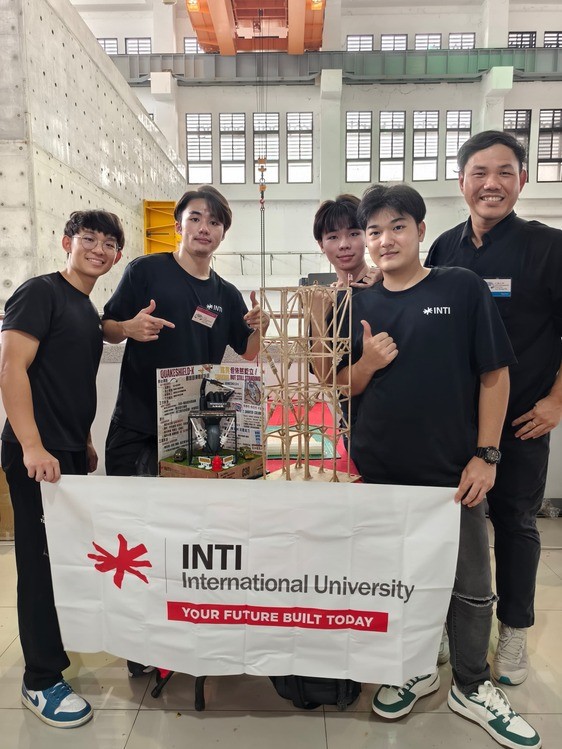
Kuah Zhun Seong and his team, supervised by Ts. Dr Lee Hoong Pin (far left), with their award-winning structural model at IDEERS 2025.
Organised by Taiwan’s National Centre for Research on Earthquake Engineering, IDEERS brings together student teams from across Asia to design, build, and test earthquake-resistant structures under strict time and material constraints. This year’s challenge required participants to construct a high-performing model capable of withstanding simulated earthquake motions on a shaking table, replicating real seismic conditions.
Led by Kuah Zhun Seong, the team competed against 49 international teams, many from established engineering institutions. Their model, Quakeshield-X, stood out for its innovative approach to structural resilience and earned recognition from the judges.
The design drew inspiration from damper systems commonly used in modern high-rise buildings worldwide. These systems absorb and dissipate seismic energy, allowing buildings to sway safely during earthquakes rather than resisting movement rigidly. Applying these real-world principles, the students incorporated an energy-absorbing mechanism that enabled their structure to bend, adapt, and recover during shaking.
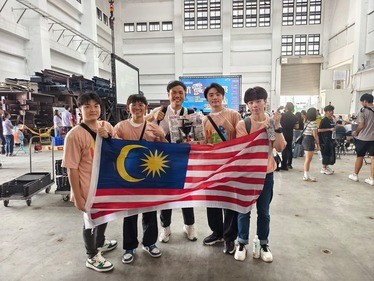
The team secured the Structural Design and Innovation Award and placed 12th out of 49 teams at IDEERS 2025.
“We wanted our design to behave like actual earthquake-resistant buildings,” Kuah said. “The idea behind Quakeshield-X was to absorb vibration energy instead of resisting it rigidly. Allowing controlled movement can make a structure safer, and that was the philosophy behind our design.”
The development process involved significant iteration. Early prototypes tested during practice sessions proved too rigid, resulting in premature cracking under vibration. This prompted the team to revisit their structural layout, refine bracing patterns, and redesign key connection joints to achieve a better balance between stability and flexibility.
“We realised quickly that stiffness alone doesn’t guarantee safety,” Kuah explained. “Earthquake engineering is about finding the sweet spot between movement and strength. That learning experience really shaped our approach.”
Working within strict material and time limitations, the team was forced to design strategically rather than rely on heavy reinforcement. Their final structure used lightweight, low-cost components arranged to distribute seismic loads efficiently, a key evaluation criterion at IDEERS, which assesses both structural performance and material efficiency.
During the final testing phase, each shaking-table round introduced progressively stronger seismic forces. The structure remained resilient through most of the sequence before reaching its failure point. Although it did not complete the entire test, its overall performance impressed the judges, earning the Structural Design and Innovation Award and a 12th-place finish.
The students’ supervisor, Ts. Dr Lee Hoong Pin said the achievement reflected both the team’s dedication and the university’s emphasis on hands-on engineering education. He noted that the university has participated in IDEERS multiple times and consistently delivered strong performances, supported by academic rigour and practical learning opportunities.
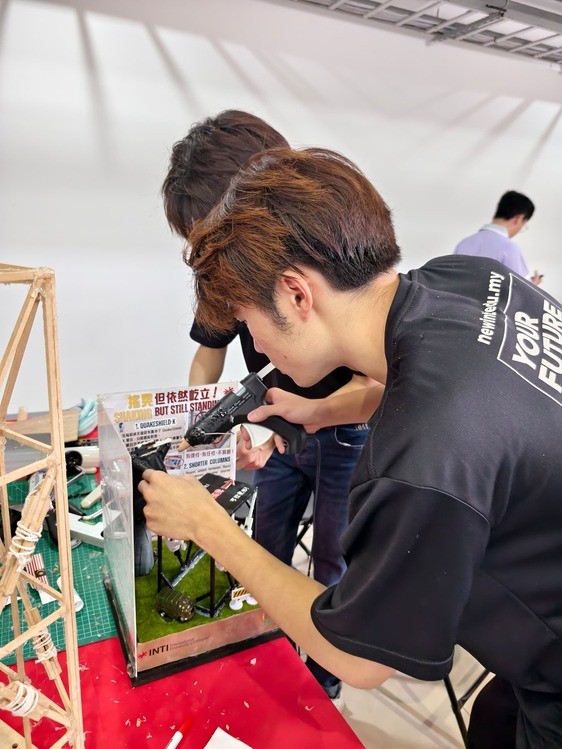
Team members constructing their earthquake-resistant model during the IDEERS competition.
Beyond technical outcomes, the students highlighted personal growth from the experience, including working under pressure, communicating effectively as a team, and learning to view failure as a necessary part of engineering innovation.
Reflecting on the experience, Kuah said, “We learned that engineering is not just about numbers and calculations. It’s about teamwork, creativity, and the courage to try again when something fails. That’s what made this experience unforgettable.”