In many flood events, the problem is not the lack of data. Water levels are monitored, sensors are deployed, and alerts are issued. Yet warnings still arrive too late, are too broad, or fail to reach the people who need to act. In Malaysia, where floods are becoming more frequent and unpredictable, this “last-mile” gap between detection and decision-making has real consequences for communities on the ground.
This gap prompted Ku Yin Ee (Elaine), a final-year Computer Science student in collaboration with Coventry University at INTI International University, to rethink how flood alerts are delivered. Rather than focusing solely on monitoring rising water levels, she set out to design a system that could ensure warnings reach the right people, in the right place, at the right time.
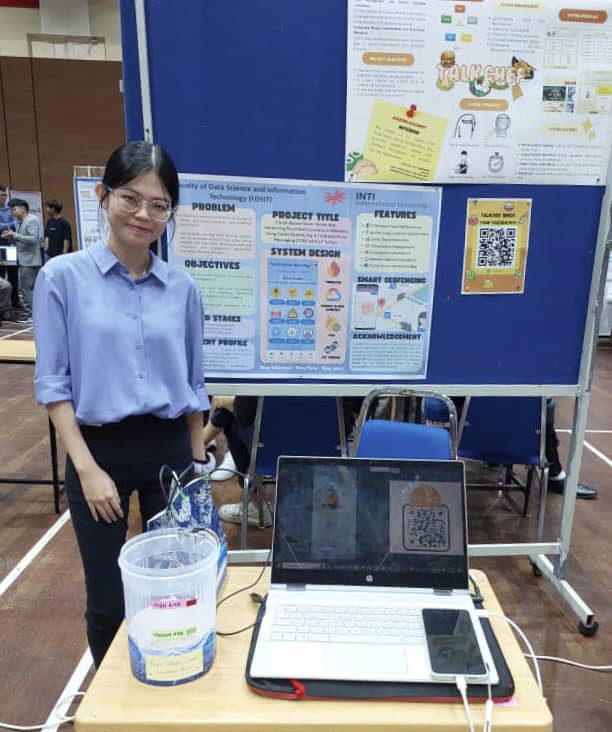
Ku Yin Ee (Elaine), a final-year Bachelor of Computer Science (Hons) student at INTI International University, whose project focuses on delivering real-time, location-specific flood warnings.
Her project, Cloud-Based Flood-Sense App: Enhancing Flood Monitoring and Alert Systems in Malaysia Using Smart Geofencing and Firebase Cloud Messaging with IoT Sensor, was developed under the supervision of Prof. Ir. Dr Malathy Batumalay. The idea emerged from repeated observations of flood-related disruptions across the country and a realisation that existing warning mechanisms often struggle to translate available data into timely, actionable alerts for affected communities.
“Almost every year, we see families displaced, homes destroyed, and even lives lost, often because warnings arrive too late or are too general,” Elaine said. “The issue isn’t the lack of data, but how quickly and accurately it reaches people.”
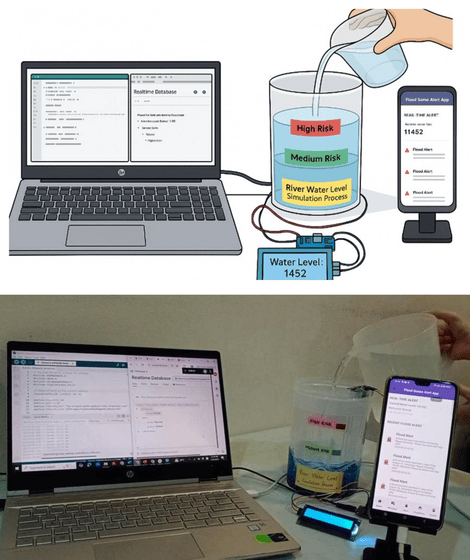
Elaine’s Flood-Sense prototype design (top) and its implementation in a working system (bottom).
To address this, Flood-Sense integrates Internet of Things (IoT) sensors, cloud computing, and mobile technologies into a single, responsive system. Ultrasonic water-level sensors connected to ESP8266 NodeMCU devices are deployed in flood-prone areas to continuously monitor rising water levels. Once predefined safety thresholds are exceeded, data is transmitted instantly to a cloud backend for automated analysis.
By removing the need for manual monitoring or intervention, the system significantly shortens response time during critical moments. Alerts are triggered immediately, allowing users to make informed decisions, such as evacuating or planning routes, while options are still available.
A defining feature of Flood-Sense is its use of smart geofencing. Virtual boundaries are set around high-risk zones, enabling the system to identify users who are physically within affected areas and send targeted alerts directly to their mobile devices.
“Targeted alerts make warnings more relevant and easier to act on,” she said. “Users receive notifications that reflect where they actually are, not general alerts that may not apply to them.”
Beyond warning notifications, the Flood-Sense mobile application provides live flood updates through an interactive map, highlights affected locations, and offers quick access to emergency contacts and safe areas. The platform also includes community reporting features that allow users to share real-time updates and on-the-ground conditions, thereby strengthening collective awareness during the early, most uncertain stages of flooding.
The system’s benefits extend beyond individual users. For authorities and emergency responders, real-time sensor data combined with geotagged community reports can support faster identification of high-risk areas, improve coordination, and enable more efficient resource deployment when time is critical.
Currently operating as a prototype with limited sensor deployment and reliance on stable internet connectivity, Elaine noted that Flood-Sense has scope for further development. Planned enhancements include wider sensor coverage, integration of rainfall and weather forecast data, improved network resilience through alternative alert channels, and the incorporation of AI-driven predictive models.
The project has already received national recognition. Flood-Sense was awarded the Gold Medal and Third Place (overall) at the Innovation Development Through Education Activities (IDEA 2025) Competition hosted by the Ministry of Youth & Sports. It also received the Best Project Award from Coventry University and the Best Student Project from U Mobile.
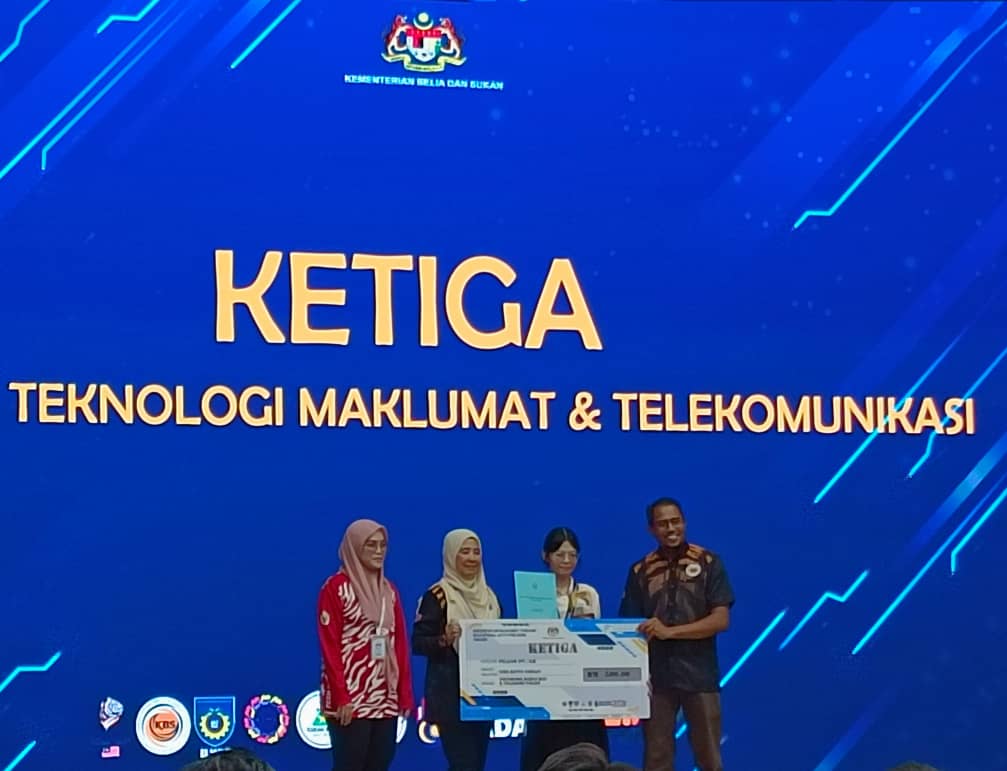
Elaine receiving the Gold Medal and Third Place (overall) at the Innovation Development Through Education Activities (IDEA 2025) Competition.
Elaine was later selected as one of the student exhibitors at the INTI Industry Partners’ Appreciation Dinner 2025, held at the EQ Hotel, where the project was presented to industry partners and members of the public, including Hannah Yeoh, who was then the Minister of Youth and Sports.
Elaine added, “As climate risks intensify, response time becomes everything. If warnings reach the right people at the right moment, even a few minutes earlier, it can change outcomes and help protect lives.”