Nina Aziz’s team experimented with artificial intelligence (AI) to present clothing online, but the results fell short of their expectations. They returned to booking models for their fashion visuals. For Zalora’s Senior Fashion Buyer, showing customers a garment’s qualities remained an important consideration.
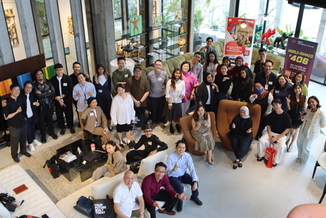
Educators and industry practitioners gathered at Ligne Roset Malaysia for INTI International College Subang’s Industry Advisory Board session for Arts & Design, held under the theme “The Irreplaceable Human: Authenticity Within the Creative Space”.
“People want to see textures, people want to see life, people want to see quality,” she said.
Nina shared her experience at INTI International College Subang’s Industry Advisory Board (IAB) session for Arts & Design, held at Ligne Roset Malaysia on 12 November 2026. Under the theme “The Irreplaceable Human: Authenticity Within the Creative Space”, educators and industry practitioners discussed how designers could work with AI while developing their judgement and individual style.
The showroom’s living and communal spaces provided a relaxed setting for educators and industry practitioners to exchange views, surrounded by examples of design in everyday use. Surrounded by furniture and interiors designed for everyday use, participants considered the relationship between how something looks, what it communicates and how people experience it.
In fashion, that experience includes how a garment fits, how its fabric falls and how it moves on a person. Nina’s account illustrated why the choice of production tools depends on what customers need to see. Designers must be able to assess whether a visual gives an audience a useful understanding of the product.
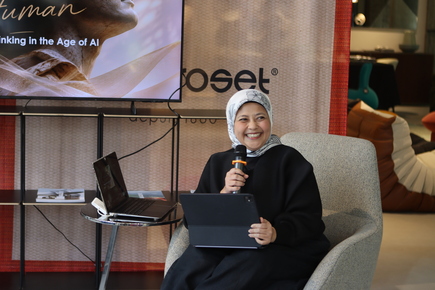
IDr Norshafina Ibrahim, President of the Malaysian Institute of Interior Designers (MIID) and Chief Executive Officer of Skala Design Consult Sdn Bhd, delivered the keynote speech and highlighted the connection between making and thinking.
For educators preparing students to make those decisions, this raises a question about the learning that takes place during the creative process. Generative AI can produce a fashion image or graphic concept from a prompt. Students still need opportunities to work out why an idea is appropriate, how it could be improved and whether it achieves the intended purpose.
IDr Norshafina Ibrahim, President of the Malaysian Institute of Interior Designers (MIID) and Chief Executive Officer of Skala Design Consult Sdn Bhd, addressed that connection in her keynote speech.
“The art of making is also the art of thinking,” she observed.
A designer develops an idea through observation, experimentation and revision. Trying an approach, seeing where it falls short and making adjustments helps build an understanding that carries into the next piece of work. Over time, those experiences contribute to creative instincts and the confidence to make independent decisions.
As AI becomes easier to use, retaining opportunities for that learning becomes an important consideration in design education. Students need to question a tool’s suggestions, explain their choices, and take responsibility for the finished work.
In graphic design, the discussion turned to what happens when the growing availability of AI tools produces increasingly similar work. TattHo Chow, Creative Director at VML Malaysia (WPP Creative), described the prevalence of generic AI-generated visuals as “AI slops”.
“We see a lot of AI slop in terms of graphic design today, and frankly, it’s a bit off-putting to the eye,” he said.
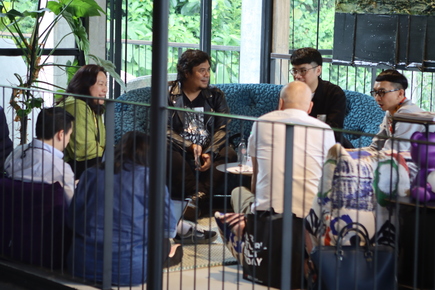
Ligne Roset Malaysia’s living and communal spaces provided a setting for educators and industry practitioners to discuss creative practice and the skills students need to develop.
TattHo encouraged designers to develop a recognisable signature style and bring their own perspective to their work. When many people can access similar tools, a designer’s interpretation of a brief, choice of ideas and individual expression help distinguish the result.
His advice gives students a practical reason to explore different approaches while studying. Meeting a brief involves understanding the audience and deciding what the design should communicate. Experimenting with how to do that gives students room to develop an approach they can recognise as their own.
“There needs to be more creativity and thought put into every design that we touch, and putting prompts into a generative AI software will just create generic designs,” he said.