Injam Hossan used to read newspapers regularly as a child in Bangladesh. As he began getting more of his information on his phone, he fell out of the habit. Then a video competition in Malaysia led him to look through old news stories.
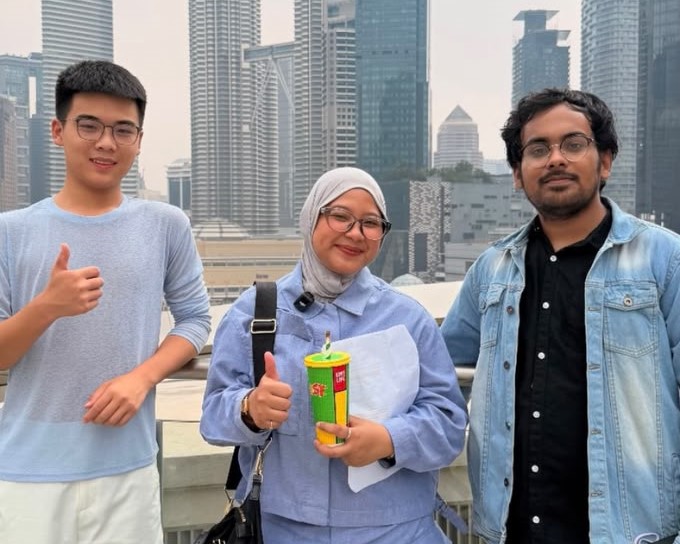
(From left) Guo Weizhen, Ratu Ranum Safarhajj and Injam Hossan of INTI International University’s Team Heritage Hunters. The UniROAR finalists made videos about Merdeka 118 and the Petronas Twin Towers.
“After the competition, I started reading The Star more,” he said.
Injam and two coursemates from INTI International University reached the finals of The Star’s UniROAR Reels Challenge. The competition asked students to turn stories from the newspaper’s archives into short social media videos. The trio made two, one about Merdeka 118 and the other about the Petronas Twin Towers.
A third-semester Bachelor of Arts (Honours) Digital Media student, Injam came across the challenge while working on a university assignment. He wanted more video-making experience and invited Guo Weizhen from China and Ratu Ranum Safarhajj from Indonesia to join him. They entered as Team Heritage Hunters.
For their first video, the trio drew on The Star’s “Malaysia’s Heritage and Future” to show the scale of Merdeka 118 and explain its historical and cultural significance. Their second video, Standing Tall, took its name from a feature published by The Star on 1 September 1999 and explored what the Petronas Twin Towers meant to Malaysians when they opened.
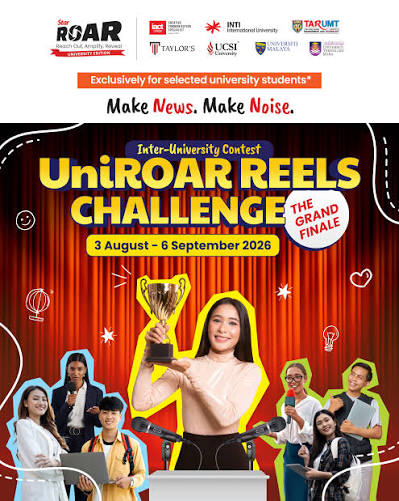
Students from seven higher education institutions across Malaysia took part in The Star’s UniROAR Reels Challenge, turning stories from the newspaper’s archives into short videos.
In one scene, Ratu gestures towards the towers, inviting viewers to look up. The camera tilts up to show their height, then drops back to Ratu for comic effect. Elsewhere in the video, a collage of old newspaper articles shows how the towers became a symbol of Malaysia’s ambition. The Reel ends by asking what it might mean for a new generation to stand tall.
Injam chose the topics and planned the scenes. Weizhen, who had made videos before, handled the editing, while Ratu, who had studied journalism in Indonesia, presented on camera. The team turned to lecturers and fellow students for help with technical difficulties and language barriers as they worked on the two entries.
“Reels can grab attention quickly and make the news easier to understand. But if you want more details, I think you should read the newspaper,” Injam said.
Weizhen hopes the videos will also introduce people outside Malaysia to the country’s history. “Short videos are easy to access. They can grab attention quickly and spread news and ideas much faster,” he said.
Nearly seven in 10 Malaysian respondents to the Reuters Institute’s Digital News Report 2026 said they used social media for news. The share using print for news fell from 45% in 2017 to 14% in 2026.
The Star created UniROAR to encourage young people to read and engage with the news. The 2026 challenge drew students from seven higher education institutions across Malaysia, and The Star featured 66 finalist videos. At the prize-giving ceremony on 12 November 2026, Goh Kok Soo, Senior General Manager, Print, Circulation and Subscription at Star Media Group, encouraged students to “keep reading, keep questioning and keep telling stories”.
In a separate session, the judges spoke about the choices students face when telling a story on screen. Dr Christina Chin, Deputy Executive Editor, Editorial (Education Desk) at Star Media Group, urged them to bring their own ideas to their work. Lina Tan, Founder, Producer, Chief Content Officer and Director of RED Communications, asked them to think about what they wanted viewers to take away. Matthew Tan Yi Jian, Lecturer in the Department of Film and Theatre at Sunway University, spoke about taking the time to understand the people whose stories they tell.
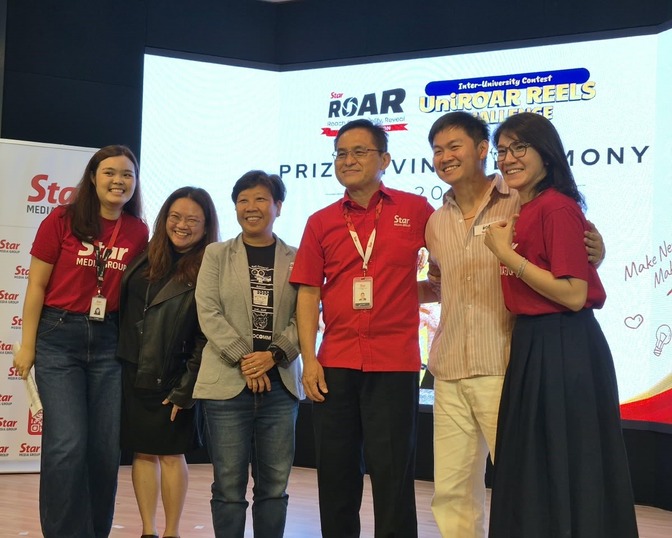
Goh Kok Soo (fourth from left), Senior General Manager, Print, Circulation and Subscription at Star Media Group, encouraged students at the UniROAR prize-giving ceremony to keep reading, questioning and telling stories.
For students wondering whether to make a video of their own, Injam drew on what he and his teammates had learnt.
“Our video was not perfect, of course, but we were brave. We tried,” he said. “By making two videos, I learned many things. So, just make videos and learn.”