Organisations may need to monitor how close people are to one another in shared spaces. But that does not necessarily mean they need to know who those people are.

A busy pedestrian crossing illustrates the wider challenge of monitoring shared spaces while considering personal privacy. One study presented at ASBC 2026 explores distance monitoring using 3D depth sensing.
A study presented at the ASEAN Social Business Conference (ASBC) 2026 examined how 3D depth sensing could help organisations obtain this information without relying on recognisable facial images. It was one of the research presentations at the conference, hosted by INTI International University on 29 October.
The study, titled “Low-Cost, Privacy-Preserving Social Distance Monitoring Using 3D Depth Sensing for Public Health Preparedness”, was presented by Dr Md Amran Hossen, Assistant Professor of Computer Science and Engineering at the World University of Bangladesh.
The proposed system uses depth measurements to estimate how far apart people are. When individuals move within a specified distance of one another, it can trigger an alert. Organisations could then identify where people are gathering closely while reducing reliance on footage that clearly shows their faces.

Dr Md Amran Hossen’s research examines how 3D depth sensing could monitor distances between people without relying on recognisable facial images.
The research focuses on public health preparedness, but the approach could also be explored in shared working areas, common spaces at schools and universities, and public transport facilities. Each setting has different needs, so it’s important to understand where distance monitoring would be useful and how the system would perform there.
The study also aims to make this type of monitoring more affordable. It proposes using relatively accessible sensing hardware and a simpler approach to distance detection to reduce the complexity associated with conventional camera-based systems.
Initial testing involved more than 11,000 frames, though the system is still in its early stages. Further evaluation would need to establish its reliability in everyday environments, while cost comparisons would help determine whether it offers an affordable option for organisations.
Dr Hossen’s presentation was listed under ASBC 2026’s Technology and Digital Innovation for Social Transformation track. Other presentations in the track examined university website accessibility, diagnostic access in low-resource communities, green technology adoption among small and medium-sized enterprises, and fake news detection.
These were part of a wider programme spanning education, sustainable business and inclusive governance. Researchers also presented work on AI feedback in language learning, microfinance, women’s empowerment and climate adaptation.
Held under the theme “Advancing Social Business for Sustainable and Inclusive Impact”, ASBC 2026 brought together academics, industry representatives, social entrepreneurs, and other stakeholders through keynote addresses, a forum discussion, and parallel research sessions, with both in-person and virtual participation.
The conference was organised by INTI International University in collaboration with the Asian University of Bangladesh, Shanto-Mariam University of Creative Technology and Politeknik Negeri Lampung, Indonesia.
In his conference message, INTI International University’s Pro Vice-Chancellor of Research and Innovation and Conference Patron, Professor Ts Dr Wong Ling Shing, explained why cross-regional collaboration matters in developing responses to social challenges.
“Asia is a powerhouse of economic dynamism, yet it remains home to diverse developmental challenges that require regionally contextualised solutions. Having a premier international platform at the Asian level is paramount. It allows scholars, policymakers, entrepreneurs, and practitioners from diverse cultural, economic, and institutional backgrounds to cross-pollinate ideas, share empirical insights, and forge cross-border collaborations.”
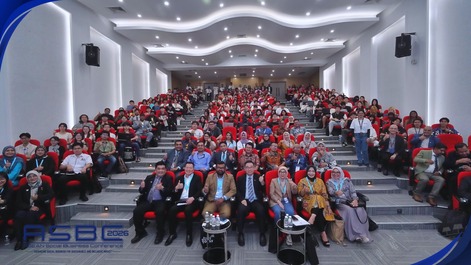
ASBC 2026 at INTI International University brought together academics, industry representatives and social entrepreneurs for a programme covering education, sustainable business, inclusive governance and digital innovation.
Conference Chair Dr Khan Sarfaraz Ali emphasised that innovation’s value should be measured by its contribution to people’s lives.
“Today, success should not be measured by profit alone, but also by the positive value we create for people, communities, and the planet,” he said.
“Achieving meaningful impact requires transformative and responsible leadership – leadership guided by purpose, empathy, integrity, innovation, and collaboration. Technology and AI can further empower social businesses, but their use must remain ethical, inclusive, and human-centred.”
For the distance-monitoring system, the next stage of research will explore longer-range sensors, including LiDAR, to extend its capabilities and investigate how it could be used across larger spaces.