The Faculty of Engineering and Quantity Surveying (FEQS) at INTI International University has launched its Digital Technology and Innovation Hub (DTI-Hub), a new learning space designed to support students as they prepare for the demands of IR 4.0 industries. The launch took place during the Spark the Future: FEQS Open Day and was officiated by Dr Md Fauzi Md Ismail, Registrar of the Malaysia Board of Technologists (MBOT), together with INTI’s leadership, industry partners, and faculty members.
The DTI-Hub serves as a hands-on ecosystem that brings together advanced training equipment, simulation tools, and digital learning systems. It is designed to strengthen students’ competencies across engineering, technology, telecommunications, and robotics.
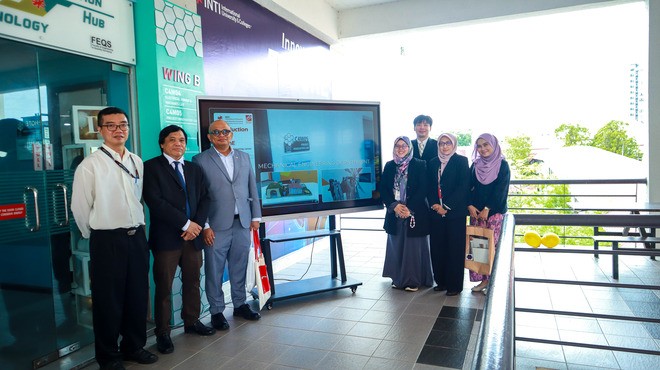
Dr Md Fauzi Md Ismail, Registrar of the Malaysia Board of Technologists, standing in front of the newly launched DTI-Hub at INTI International University, together with representatives from the Faculty of Engineering and Quantity Surveying.
Professor Dr Shamsul Nahar Abdullah, Pro Vice-Chancellor (Academic Operations) of INTI International University, highlighted the importance of the new facility. “The DTI-Hub is a crucial step in ensuring our students are ready for the demands of a rapidly evolving industry,” he said. “By giving them access to advanced digital tools and hands-on learning environments, we are strengthening their ability to innovate, solve problems, and contribute meaningfully to the nation’s technological growth.”
To support these goals, the Hub features a range of industry-grade technologies, including a robotic arm, PLC training systems, materials testing equipment, and drone technology. These facilities will help students explore manual and automated processes, network communication, data processing, robotics integration, and real-time simulation commonly used in industry.
Dr Md Fauzi Md Ismail said the launch aligns with the nation’s commitment to developing professional technologists. “We take pride in seeing institutions like INTI taking strategic steps to align their programmes and initiatives with industry needs and MBOT’s competency requirements,” he said. “Such steps bridge the gap between academic and real-world application, ensuring that graduates today are not only employable, but also industry-ready and globally competitive.”
He added that competency-based training and professional recognition are essential, and that INTI’s focus on practical, industry-relevant learning supports MBOT’s goal of producing technologists and technicians with the skills and knowledge required by the sector.
In line with MBOT’s focus on competency-based development, INTI currently has five programmes with provisional accreditation status. The collaboration, which began more than 10 years ago, continues to focus on preparing future technicians and technologists to meet workforce expectations.
With new upgrades in telecommunications, automation, materials testing, robotics, and IoT systems, the DTI-Hub will serve as a central space for experimentation and innovation. Students will be able to translate theoretical knowledge into real applications, strengthening both technical and problem-solving abilities.
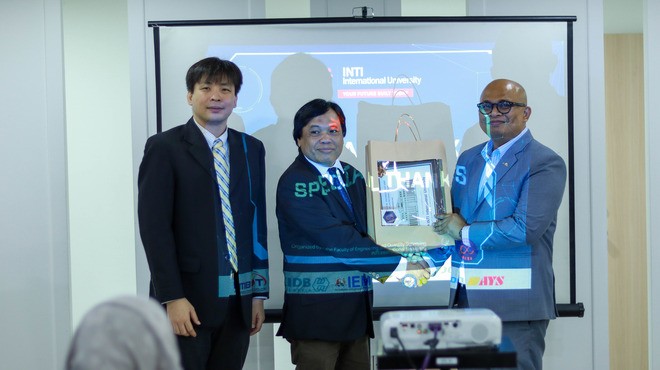
(From left) Associate Prof Dr Chuah Keng Hoo, Interim Dean of the Faculty of Engineering and Quantity Surveying at INTI International University, and Prof Dr Shamsul Nahar Abdullah, Pro Vice-Chancellor (Academic Operations), presenting a token of appreciation to Dr Md Fauzi Md Ismail, Registrar of the Malaysia Board of Technologists.
The launch also included demonstrations by faculty members and student ambassadors, who showed how the DTI-Hub’s facilities can support class projects, capstone work, and research. Industry partners in attendance expressed strong support for the initiative and emphasised the importance of graduates who are comfortable with emerging technologies and industry-standard equipment.
As INTI moves forward with its focus on developing future-ready talent, the DTI-Hub will play a key role in supporting FEQS’s commitment to producing graduates who can contribute effectively to Malaysia’s engineering and technology landscape